British citizenship quiz: 10 practice questions to pass

Ready to check your knowledge for the Life in the UK Test without overwhelm? This British citizenship quiz gives you realistic practice questions, quick explanations, and a smart way to plan your prep.
Below you’ll find: what this practice covers, a 2026 test overview, 10 sample questions with answers, how to score yourself, and a fast study plan using the Life in the UK Test App.
What this quiz covers (and how it differs from the real test)
This is a practice British citizenship quiz aligned to the Life in the UK Test syllabus. It mirrors the exam’s multiple-choice style across history, government, culture, and everyday life. Use it to assess your baseline and learn from concise explanations.
Aligned to the handbook: Topics reflect the official “Life in the UK: A Guide for New Residents”.
Practice, not official: This uk citizenship quiz is for preparation only. The real test must be booked on GOV.UK.
How to use this guide:
Answer the 10 questions under timed conditions (about 6–7 minutes).
Check the explanations to fix misconceptions.
Map your score to readiness and follow the next-step plan.
Drill full-length mocks and track progress in the app.
Life in the UK Test at a glance (2026 update)
Here’s a quick summary of the real exam and how practice fits into an effective study plan:
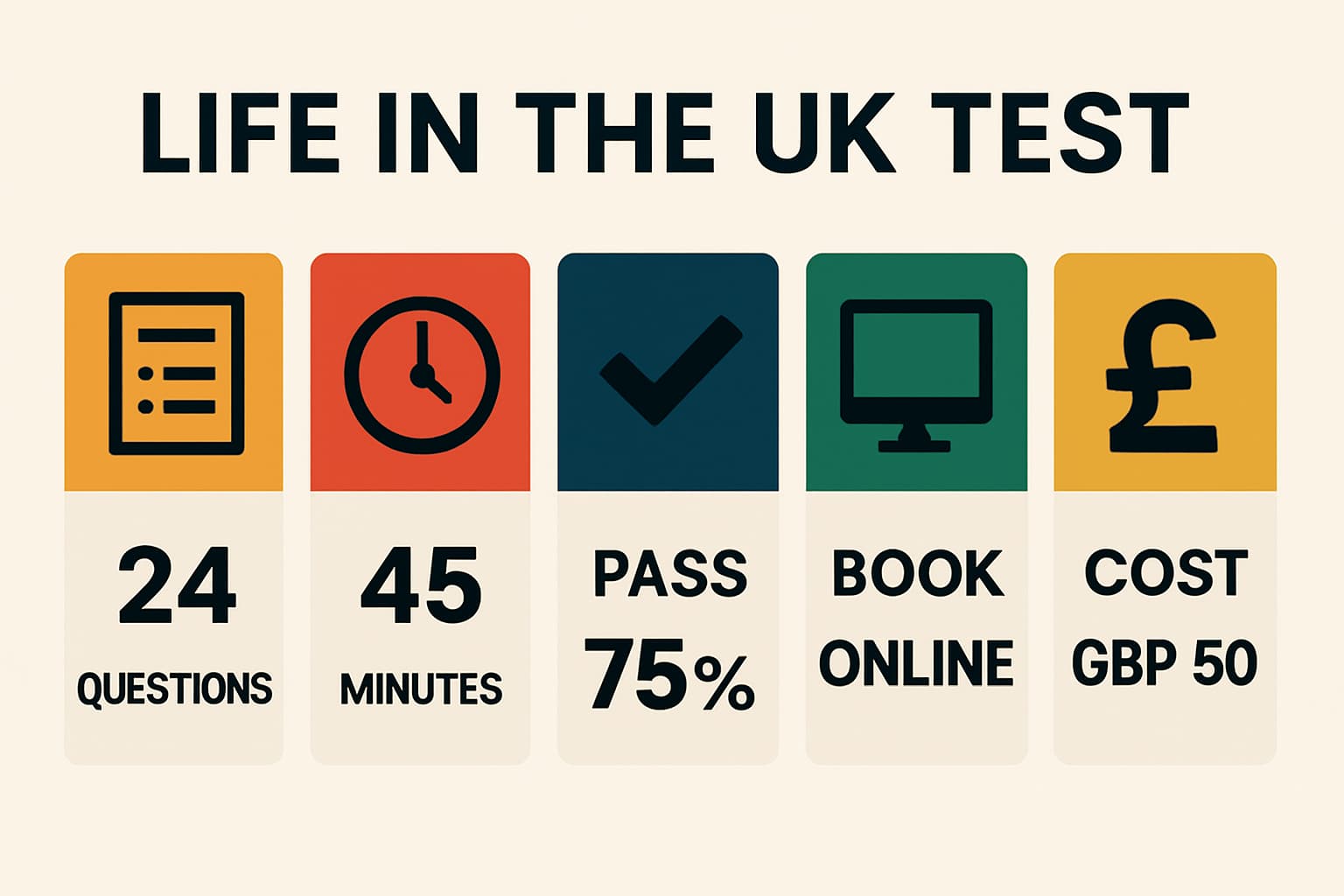
Format: 24 multiple-choice questions, computer-based, 45 minutes.
Pass mark: 75% (get at least 18 correct).
Topics: British traditions, customs, history, laws, political system, and daily life based on the official handbook.
Booking: Online via GOV.UK at least 3 days in advance; cost GBP 50; bring approved ID; you cannot bring children or family.
On the day: You’ll get your result the same day and a unique reference number if you pass, which you’ll need for your citizenship or settlement application.
Structured practice is the fastest route to a first-time pass: cycle questions, review explanations, then sit realistic mocks until you reliably score 80%+.
Quick win: If you prefer learning on the go, the Life in the UK Test App gives you the full handbook optimised for mobile, 650+ questions with explanations, realistic mocks, and a personalised Readiness Score so you always know when you’re exam-ready.
Download on App Store | Get it on Google Play
Free British citizenship test quiz — 10 sample questions
Try these exam-style questions to gauge your readiness before committing to full prep. Answer first, then check the explanations below.
Mock Test: Questions 1–10 (mixed topics)
Which city is the capital of Scotland?
A) Glasgow
B) Edinburgh
C) Aberdeen
D) Dundee
Which statement about the UK government is correct?
A) The Monarch is the head of government
B) The Prime Minister is the head of government
C) The Speaker forms the government
D) The House of Lords forms the government
When is St David’s Day celebrated?
A) 1 March
B) 17 March
C) 30 November
D) 23 April
Who built Hadrian’s Wall?
A) The Vikings
B) The Normans
C) The Romans
D) The Anglo-Saxons
What is the minimum age to vote in UK general elections?
A) 16
B) 17
C) 18
D) 21
The Battle of the Somme took place during which war?
A) The Boer War
B) The First World War
C) The Second World War
D) The Crimean War
Which organisation helps to preserve historic buildings and countryside in the UK?
A) The National Trust
B) The British Council
C) The BBC
D) The Red Cross
What is the Church of England also known as?
A) Presbyterian Church
B) Methodist Church
C) Anglican Church
D) Baptist Church
Which body has devolved powers over education and health in Scotland?
A) UK Parliament
B) Welsh Parliament (Senedd)
C) Northern Ireland Assembly
D) Scottish Parliament
What are the two Houses of the UK Parliament?
A) House of Councillors and House of People
B) House of Commons and House of Lords
C) House of Deputies and Senate
D) National Assembly and Senate
Answers and concise explanations
Answers for Questions 1–10
B) Edinburgh — Scotland’s capital; Glasgow is the largest city. Memory cue: E for Edinburgh, E for “executive” capital.
B) The Prime Minister is the head of government — The Monarch is head of state; the PM leads the government formed from the House of Commons.
A) 1 March — St David is the patron saint of Wales; other days: St Patrick 17 March, St Andrew 30 November, St George 23 April.
C) The Romans — Built under Emperor Hadrian to mark the northern frontier of Britannia.
C) 18 — The UK voting age for general elections is 18.
B) The First World War — The Somme (1916) was one of the largest battles on the Western Front.
A) The National Trust — A conservation charity protecting historic places and natural landscapes.
C) Anglican Church — The Church of England is the established church in England and part of the Anglican Communion.
D) Scottish Parliament — Education and health are devolved matters in Scotland.
B) House of Commons and House of Lords — Together they form the UK Parliament at Westminster.
Tip: Don’t just memorise answers. Always read the explanation — it cements the concept and helps you answer variants of the same question.
Score yourself: what your result means
Use your 10-question score to decide next steps. The real exam requires 75% (18/24). Aim to consistently hit 80%+ in mocks to build a safety margin.
If you scored 0–5/10: build foundations
Start with core chapters in the handbook (nations and landmarks, key historical periods, political system).
Work through guided modules in the app, then take short quizzes after each topic.
Read this primer: How to Prepare for the Life in the UK Test.
If you scored 6–8/10: close knowledge gaps
Use spaced repetition and review explanations for any incorrect items.
Sit mixed-topic mocks; keep a mistake log.
Check the pass threshold and timing tips: pass mark and results explained.
If you scored 9–10/10: polish for exam day
Do timed full-length mocks (try Mock Test 2 and Test 3 in the app) and review only the questions you flagged.
Switch on Hard Mode to simulate tougher variants and exam pressure.
Avoid last-minute cramming — instead, lightly review your mistake log and rest well.
Study smarter with the Life in the UK Test App
If you feel overwhelmed by the handbook or short on time, the Life in the UK Test App turns study into a clear, trackable plan. It solves four common problems:
Too much content? The complete handbook is broken into mobile-friendly bites, with Brit‑Bear guiding what to do next.
Not sure you’re ready? The adaptive Readiness Score shows when you’re exam-ready.
Weak explanations? 650+ questions include concise, syllabus-aligned explanations and memory cues.
No time to sit at a desk? Offline access lets you revise anywhere.
Why this app beats PDFs and random web quizzes
Structured, syllabus-aligned: No guesswork about what to study next.
Realistic mocks: Timed, mixed-topic tests (including Hard Mode) build exam stamina.
Progress you can trust: A live Readiness Score replaces “I hope I’m ready” with evidence.
Fewer repeat attempts: Clear feedback loops reduce the risk of paying again to retake.
Key features you’ll use: Brit‑Bear tutor, Readiness Score, Hard Mode, offline access
Brit‑Bear tutor: A friendly in-app assistant that prioritises topics and explains tricky areas.
Readiness Score: Tracks accuracy, speed, and coverage to forecast pass probability.
Hard Mode: Tougher distractors and stricter timing to simulate exam pressure.
Offline access: Download modules and keep learning on the bus or during breaks.
7‑day crash plan using the app (from zero to exam-ready)
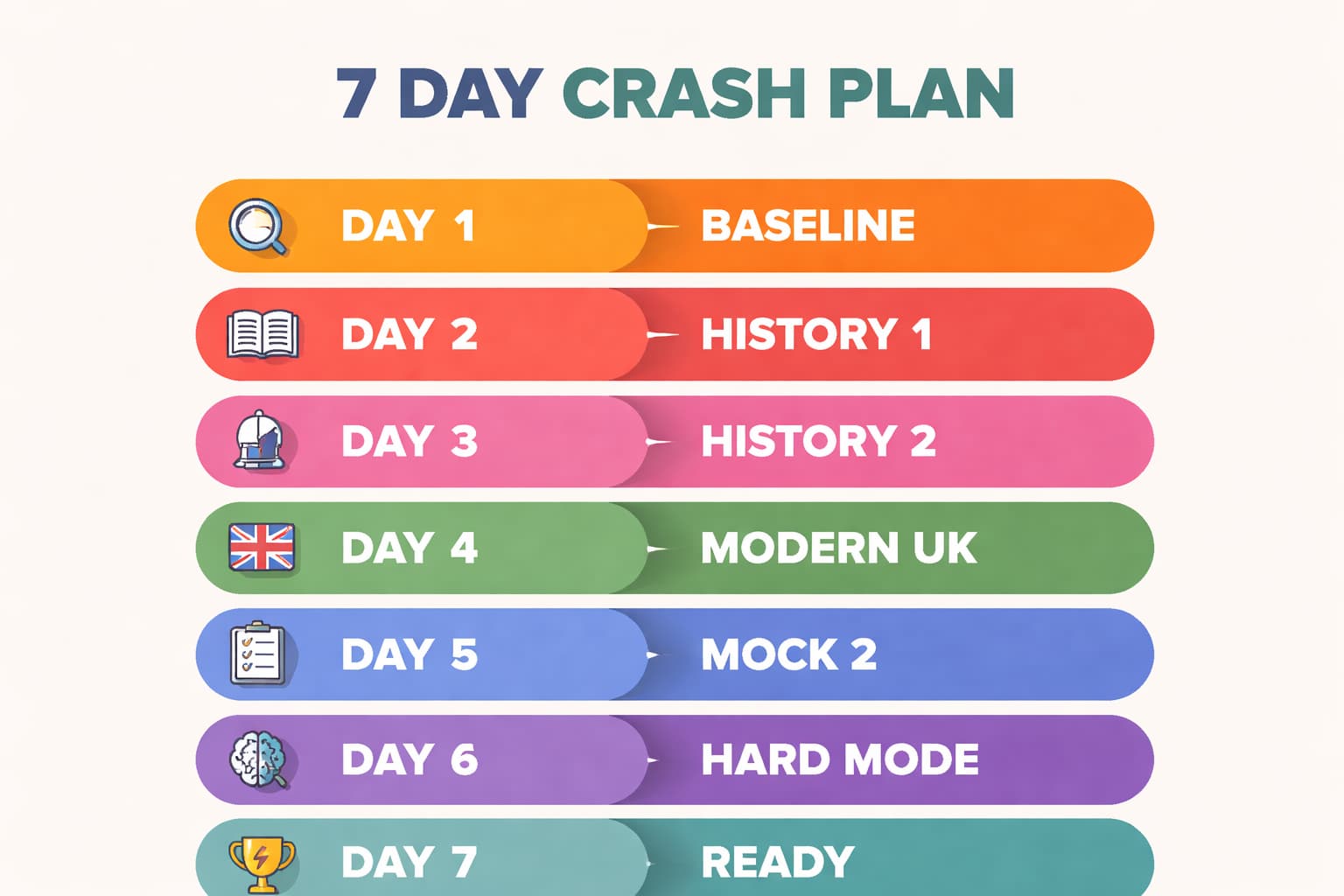
Day 1: Baseline quiz, then read overview chapters (nations, values, government). Note weak areas.
Day 2: Early history to Tudors. Do 2 short quizzes; review all explanations you miss.
Day 3: From the Stuarts to the 20th century. One mixed quiz; create a mistake log.
Day 4: Modern UK life, law, and political system. End with a 24‑question mock.
Day 5: Mock Test 2 (timed). Review only flagged questions; re-read those handbook sections.
Day 6: Hard Mode mock. Aim for 80%+. Focus on speed and accuracy.
Day 7: Light review, final mock, check Readiness Score. Book your test if consistently 80%+.
Common mistakes to avoid (and how the app prevents them)
Cramming the night before → The app schedules short daily sets and reminds you to space learning.
Rote memorisation only → Every question includes a short explanation to build understanding.
Skipping weak topics → Brit‑Bear highlights your gaps and sends targeted drills.
Not practising timing → Timed mocks (including Test 3 and Hard Mode) build speed safely.
Download on App Store | Get it on Google Play
Download and start now
Turn today’s quick check into a pass plan. Continue with full-length quizzes, Hard Mode mocks, and a Readiness Score that tells you when to book.
Get the Life in the UK Test App
FAQs: British citizenship quiz vs the real exam
Is this quiz the official Life in the UK Test?
No. This is a practice British citizenship test quiz to help you prepare. The official exam is booked and taken via GOV.UK at approved centres only.
How many questions and how is it scored?
The real exam has 24 questions and lasts 45 minutes. You must score 75% or more (18 correct) to pass. Practise with timed mocks until you hit 80%+ consistently.
What happens if I fail — can I retake?
Yes, you can retake as many times as needed, but you must pay each time. Review explanations, target weak topics, and use realistic mocks to avoid repeat attempts.
When should I book my test?
Book at least three days in advance on GOV.UK. A good rule: book when your mock scores and Readiness Score both show 80%+ on multiple days.
Do I need anything besides this test?
For many citizenship or settlement applications, you may also need to prove English with an approved SELT. Check GOV.UK for current requirements.
Related guides and next steps
UK Citizenship Pledge & Ceremony: what to expect
After passing, you’ll attend a ceremony where you make the pledge/oath and receive your certificate. We’ll cover documents, timings, and etiquette in our upcoming guide.
Citizenship versus Nationality in the UK: key differences
Confused by terminology in study materials? Read our explainer on citizenship versus nationality in the UK.
What is a British citizenship certificate?
It’s the official proof of citizenship issued after you complete the process and ceremony. Keep it safe — you’ll use it for passport applications and records.
More helpful reads: how to book the Life in the UK Test, avoid common mistakes to avoid, and pass mark and results explained.
Sources and further reading
Official guidance on Life in the UK Test and what happens at the test.
Caseworker guidance on format and results: Knowledge of Life in the UK.
Booking portal: Life in the UK Test Booking.
Citizens Advice on retakes and requirements: Applying for British citizenship.
English language (SELT) overview: Prove your English.