Dual citizenship UK: clear rules, two passports explained
Dual citizenship UK explained for 2026: rules, two passports, country exceptions, taxes and travel. Clear steps and tools. Learn how today.
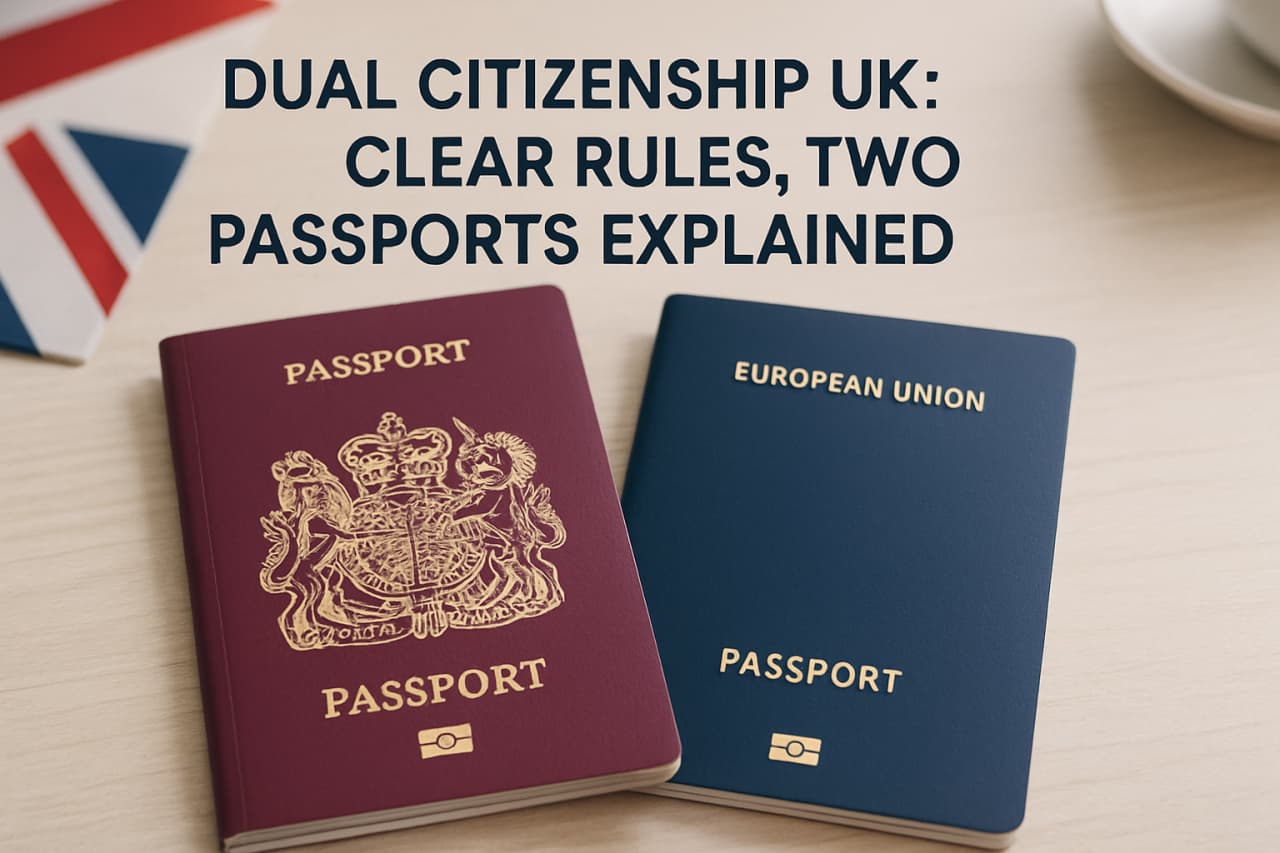
Thinking about dual nationality or already juggling two passports? Here is the 2026, UK‑specific guide that turns confusing rules into clear steps. You will learn what dual citizenship really means, when you can hold two passports, which one to use at the border, and how to avoid costly mistakes.
We will also cover tax, children, timelines, and a smarter way to pass the Life in the UK Test on your first try.
Still on the way to citizenship?
Pass the Life in the UK Test before doing your dual-nationality paperwork
If dual citizenship is your goal, clearing the Life in the UK Test early keeps the route moving and removes one of the main pre-application hurdles.
- Handle the test while your citizenship plan is still simple and focused
- Practice for the Life in the UK Test with realistic mock tests
- Know exactly when you are ready to pass the test
Scan to download the app
Works on iPhone and Android


What the dual citizenship really means in 2026
Dual citizenship (dual nationality) means you are legally a citizen of the UK and at least one other country at the same time. It is a legal status, not just owning two passports.
UK law recognises dual and even multiple nationality. The main watch‑out is that your other country’s laws may be stricter. Throughout this guide, we will flag common pitfalls and give practical, border‑tested tips.
Who this guide is for
- Newly naturalised British citizens and those with ILR/settled status planning citizenship soon.
- UK‑born Brits with a second nationality by descent or registration.
- Parents managing passports for dual‑national children.
- Professionals who travel often and need to minimise visa friction.
UK policy on dual nationality: the essentials
Can you have dual citizenship? In general, yes under UK law. The UK recognises dual and multiple nationality and allows British nationals to hold a British passport even if they have another citizenship. Your other country’s rules still apply and may restrict dual status.
The major Home Office white paper was published on 12 May 2025. As of April 2026, the key point for dual nationals is this: the UK still recognises dual nationality. The later policy changes were mainly about how some migrants may reach settlement and then citizenship, not about banning two passports.
What changed after 12 May 2025
- 20 November 2025: the Home Office published A fairer pathway to settlement and an earned-settlement consultation. These proposed a default move from 5 years to 10 years for settlement for most migrants, with faster or slower routes depending on contribution. The same statement said partners of British citizens would stay on a 5-year settlement path and EU Settlement Scheme grants would remain unchanged. The same papers say citizenship reform would follow settlement reform and would need legislation.
- 5 March 2026: a later Statement of Changes in the Immigration Rules confirmed a higher B2 English requirement for settlement on many routes, but the change does not start until 26 March 2027.
- Travel update for 2026: current ETA guidance says dual citizens with British or Irish citizenship cannot get an ETA and must prove that citizenship with the right passport or a certificate of entitlement.
If you already qualify for British citizenship under today’s rules, the practical takeaway is timing: future settlement or citizenship routes may get harder, but the UK’s basic recognition of dual nationality has not changed.
When the UK allows dual citizenship
- Naturalised or registered British citizens can usually keep other nationalities.
- British by birth or descent can retain additional nationalities acquired later.
- Holding multiple passports is fine if each nationality remains valid.
Important 2025 to 2026 update for Irish citizens
Irish citizens already benefit from the Common Travel Area, but there is now also a dedicated British-citizenship route for many of them. Guide B3 says eligible Irish citizens can register as British citizens after 5 years of lawful UK residence and good character, without using the usual ILR-plus-12-month naturalisation route. Ireland allows dual nationality, so this is one of the clearest current UK dual-citizenship pathways.
Planning your route to citizenship? See our step‑by‑step guides on how to get British citizenship and the Indefinite Leave to Remain roadmap.
When your other country may not allow it
Some countries limit or prohibit dual nationality and can automatically revoke citizenship when you acquire another. Always check the embassy or consulate of your other country before applying for British citizenship or a second passport.
Can I have two passports? Practical rules and scenarios
If both countries allow it, you can hold a British passport and your other passport. Here is how to use them without issues.
Applying for and renewing passports on both sides
- Time it right: Apply for your first British passport as soon as your citizenship certificate arrives. Some people keep their other passport valid to avoid travel gaps.
- Match your identity: Keep your full name, date of birth, and place of birth consistent. If you change your name, update both countries and keep documentary proof.
- Evidence: For a first British passport, you will need your naturalisation/registration certificate and supporting proof. For renewals, ensure biometrics and photos meet each country’s standards.
- Avoid conflicts: Do not list conflicting marital status, addresses, or name spellings across applications. Mismatches trigger delays.
Use our guides to speed things up: how to apply for your first British passport and the post‑ceremony passport checklist.
Which passport to use at the border
Border rules: the fast answer
- Enter and leave the UK on your British passport.
- Enter and leave your other country on that country’s passport (for countries that require it).
- For third countries, choose the passport that gives the best visa‑free access or easiest eVisa/ESTA/ETA.
- Always travel with both passports when practical.
Tip: Bookings can be made with either passport, but ensure the passport used for advance passenger information and any visas/eTAs is the one you will present at the border.
UK ETA update: if you are a dual citizen with British or Irish citizenship, you cannot apply for an ETA. Travel with a valid British passport, a valid Irish passport, or another valid passport containing a certificate of entitlement.
Schengen, ESTA, eTAs, and visas when you have two passports
- Schengen: If your second nationality is from an EU/EEA state, use that passport for visa‑free stays and EU lanes.
- USA: US citizens must enter/exit on a US passport. Otherwise, check eligibility for ESTA on the passport you will use.
- UK ETA: British and Irish dual citizens are ETA-exempt, but they must carry the passport or right-of-abode document that proves that status.
- Canada/Australia/NZ: eTAs/eVisitors link electronically to the specific passport. Apply and travel with the same one.
- Consistency: The passport used for the visa must be the one you present at the border, or the system will not find your permission.
Countries that allow dual citizenship with UK
Below is a practical snapshot. Laws change, so confirm details with the relevant embassy before making applications or declarations.
Generally permissive: EU/EEA, US, Canada, Australia, New Zealand
- Most EU/EEA countries now broadly permit dual nationality. Notable reforms (e.g., Germany) expanded dual allowances.
- US, Canada, Australia, and New Zealand generally permit dual citizenship without formal loss.
- Caveats: Some countries impose reporting or military‑service obligations even if dual nationality is allowed.
Mixed or conditional: South Africa, Pakistan, Philippines, Turkey
- South Africa: Typically requires a formal retention letter before voluntarily acquiring another nationality.
- Pakistan: Permits dual citizenship with specified countries, including the UK; notification and valid documents (e.g., NICOP) matter.
- Philippines: Offers retention or re‑acquisition processes; keep certificates safe for passport renewals.
- Turkey: Generally allows dual nationality but requires notification to civil registry.
Restrictive or prohibited: India, China, Japan, Singapore
- India: Dual citizenship is not permitted. Acquiring another citizenship can cause automatic loss. OCI is not citizenship.
- China: Dual nationality is not recognised; acquiring a foreign nationality may impact Chinese nationality and registration.
- Japan: Traditionally requires choosing one nationality by a certain age; strict rules apply to adults.
- Singapore: Generally prohibits dual citizenship for adults; renunciation can be required at 21.
Always check current law with your embassy or consulate before you apply for, renew, or use a second passport.
Legal and practical implications to consider
This section highlights areas where dual nationals most often face surprises.
Tax residence, double tax treaties, and reporting
- You can be tax resident in the UK and another country at the same time (dual residence). Tie‑breaker rules in double taxation agreements (DTAs) often resolve this.
- HMRC helpsheet HS302 explains how to claim full or partial UK relief if a DTA applies. No DTA means no treaty relief.
- DTAs usually do not cover gains from selling UK residential property.
- If you are treaty‑resident in the other country, you may claim reliefs available under that treaty.
Not tax advice: Keep evidence of your days in each country, employment contracts, and home ties. Speak to a cross‑border tax adviser if your situation is complex.
Military service, jury duty, and civic obligations
- Some countries still have conscription or reserve obligations that apply to citizens, even if they live abroad.
- Jury duty, voting, and emergency service obligations vary. Check both countries’ rules and keep your addresses current.
Security clearances and sensitive employment
- Dual nationality is not automatically disqualifying in the UK, but it must be declared during security vetting.
- Some roles (defence, intelligence) may scrutinise foreign ties or require additional checks.
Children and dual citizenship
Children can be dual nationals by birth, descent, or registration. Your steps depend on where the child was born and the parents’ statuses at the time.
Birth in the UK vs. descent from British parent(s)
- UK‑born: A child is automatically British if, at birth, at least one parent was British or “settled” (ILR, permanent residence, or equivalent).
- Descent: A child born abroad to a British parent who is not “by descent” is often British automatically. Later generations usually require registration.
Registering a child born abroad as British
- Check eligibility for registration and gather proof of the British parent’s status at the child’s birth.
- Plan passports: some families apply first for the local passport to enable travel, then the British passport once registration is granted.
- Keep name, place of birth, and parental details consistent across both countries.
After your citizenship ceremony: passports and next steps
Use this post‑ceremony checklist to stay compliant and travel‑ready.
Applying for your first British passport
- Documents: citizenship certificate, biometric photo, and identity evidence.
- Names: align your name exactly with your other passport and civil records; carry change‑of‑name proof if applicable.
- Timing: standard processing varies; avoid non‑refundable trips until you hold the passport.
Step‑by‑step help: first British passport guide and post‑ceremony checklist.
Travel planning in the first 6 months
- Keep your other passport valid until your British passport arrives.
- If your other country restricts dual nationality, confirm if you must notify or obtain retention before your UK ceremony.
- For each planned trip, decide which passport gives the best entry route and apply for any eVisas/eTAs on that passport.
- Once you become British, do not assume your citizenship certificate, BRP, or digital status will work for travel in the same way as before. Plan to use a British passport or certificate of entitlement for UK entry.
Risk management: avoid common mistakes
Prevent delays, refusals, or accidental loss of nationality with this quick checklist.
Name changes, mismatched details, and biometrics
- Keep consistent names, dates of birth, and places of birth across all documents.
- Update both countries when you change your name; carry documentary proof when you travel.
- Ensure photo and biometric standards match each issuing authority’s rules.
Renunciation traps and automatic loss rules
- Some naturalisation oaths or military service steps abroad can trigger automatic loss in certain countries.
- Missing a “retention/notification” deadline can void your other nationality.
- Before applying for a second passport, confirm your other country’s current rules with its embassy.
Timeline and tools for a smooth dual national life
Here is a simple 12‑month plan you can adapt. Set calendar reminders the day you receive your citizenship certificate.
- Month 0: Ceremony and certificate. Scan and store securely.
- Weeks 1–2: Apply for your British passport; keep your other passport valid for travel.
- Month 1: Align names across bank, HMRC, DVLA, and your other country.
- Month 2: If required by your other country, submit retention/notification.
- Month 3: Add renewal reminders for both passports (9 months before expiry).
- Month 6: Review tax residence and any treaty claims with an adviser.
- Month 12: Audit visas/eTAs, children’s passports, and biometrics.
Document vault and renewal calendar
- Keep encrypted copies of passports, citizenship certificates, retention/notification letters, and children’s documents.
- Set recurring calendar reminders: passport renewal minus 9 months, visa/eTA expiry, tax filing dates.
- Store embassy contact details and airline booking references for quick retrieval while travelling.
Citizenship still ahead?
Pass the Life in the UK Test the part of your citizenship process
The sooner you pass the test, the sooner you can focus on getting your UK citizenship and passport.
- Use a structured study plan that fits around citizenship paperwork
- Build towards a first-time pass with realistic mock tests
- Free up your attention for passports and dual-nationality decisions
Scan to download the app
Works on iPhone and Android
If you are still planning your route, read Applying for British Citizenship: Your 2026 Success Plan.
Quick FAQs
Can you have dual citizenship with the UK? Yes under UK law, but check your other country’s rules to avoid automatic loss.
Did the UK ban dual citizenship after the 12 May 2025 white paper? No. The UK still recognises dual nationality. The main later changes were proposals on settlement and citizenship timing, plus specific travel and English-language rule changes.
Can I have two passports UK? Yes if both countries allow it. Use your British passport to enter/exit the UK and your other passport for that country.
Which passport should I use for visas or eTAs? Apply on the passport you will present at the border and keep the same passport in your booking.
Does dual nationality affect tax? It can. DTAs and residency tie‑breaker rules may reduce double tax. Get advice for complex cases.
Are children automatically British? If born in the UK and a parent was British or settled at birth, usually yes. Otherwise, consider registration.
Official resources and further reading
- UK recognition of dual nationality and standard naturalisation routes: Guide B2, Form AN guidance, and the GOV.UK citizenship overview.
- Irish citizens and dual British-Irish nationality: Guide B3 for Irish citizens.
- Post-12 May 2025 policy timeline: the 12 May 2025 white paper, the 20 November 2025 settlement statement, the earned-settlement consultation, and the 5 March 2026 Statement of Changes memo.
- UK border travel and ETA rules for dual citizens: When you do not need an ETA.
- Good-character issues for citizenship applications: Good character requirement guidance.
- Tax residence, double tax agreements, and reliefs: HS302 Dual residents, Taxed twice guidance, RDR1 residence guidance, and HMRC International Manual (treaty residence).
Related reads on our site: How to Get British Citizenship and Indefinite Leave to Remain: Roadmap.
This article is for general guidance only and is not legal or tax advice. Always confirm requirements with official sources or a qualified professional.
Last updated
April 7, 2026