After the Life in the UK Test: Pass, Fail, Next Steps
Life in the UK Test results explained in 2026: pass, fail, URN, timelines, and next steps for ILR or citizenship. Clear actions and tools. Learn how.

You’ve just finished the Life in the UK Test—now what? Whether you passed or didn’t this time, the first 48 hours matter. This guide explains results in 2026, how the URN works, what to do next for ILR or citizenship, and how to avoid costly retakes.
Start Here: Understand Your Result and What It Means in 2026
Results are usually delivered online via your test provider account (PSI/LitUK) and by email. You’ll see a pass or fail and your Unique Reference Number (URN) if you passed. Keep calm—your next steps are straightforward.
-
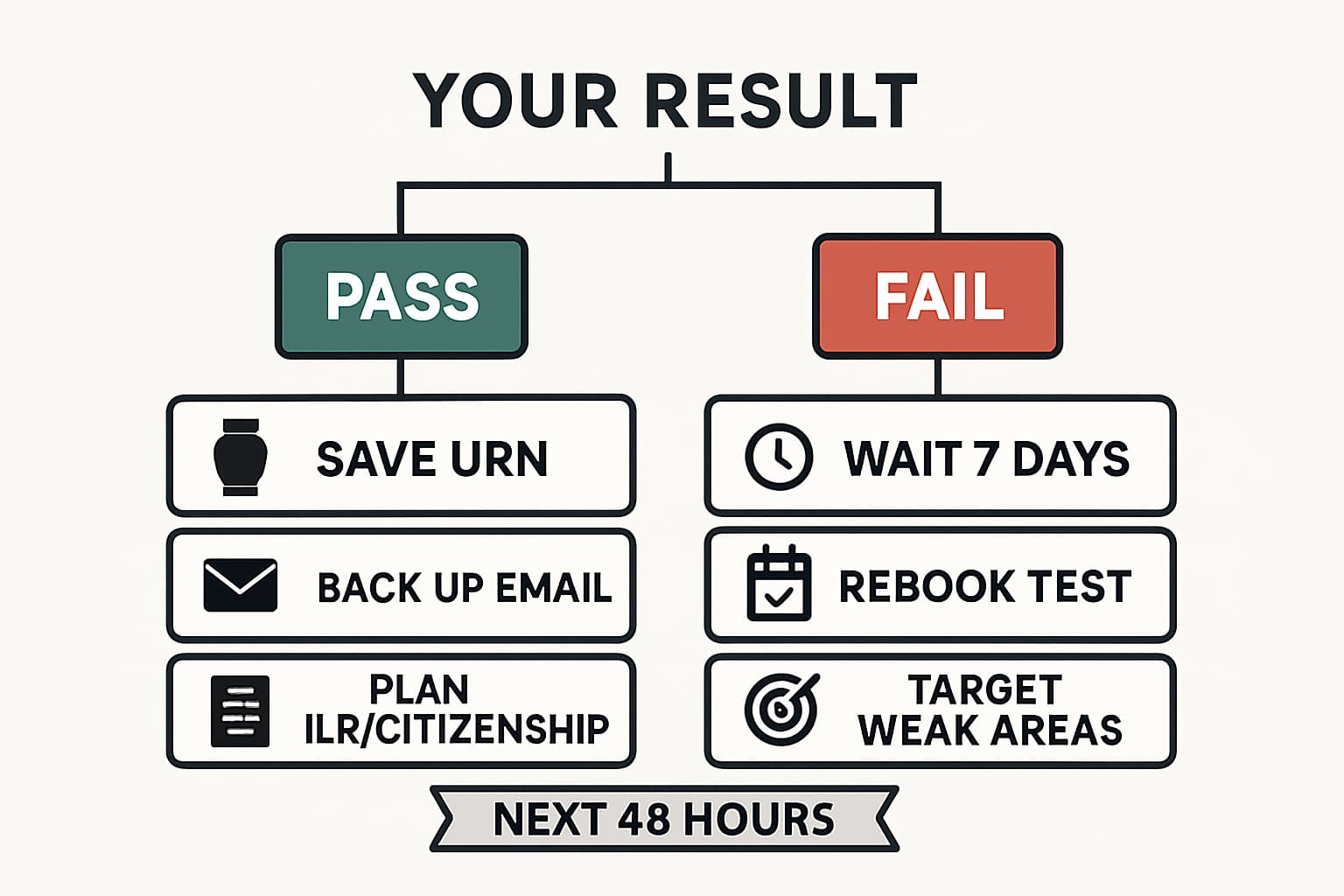
If you passed: save your URN immediately, back up your confirmation, and move on to ILR or citizenship planning.
-
If you failed: you can rebook after a short wait. Use the next week to fix weak areas and practise under timed conditions.
Key facts (check the latest official guidance):
-
You must answer at least 18 out of 24 questions correctly (75%) to pass. You have 45 minutes. Official guidance
-
If you fail, you must wait at least 7 days to rebook, and each attempt has a fee (currently £50). Retake rules Fee reference
Result Formats: Pass Letters, Fail Notices, and Score Summaries
What you see in 2026: Since 17 December 2019, most candidates no longer receive a paper pass notification letter. Instead, you access your result and URN via your PSI/LitUK account and result email, which you can download or print for your records. Home Office caseworker guidance
-
Pass: online confirmation and email showing your URN. Save a PDF and at least two backups.
-
Fail: online and email notice. It may not include detailed scores; focus on rebooking and targeted study.
-
Score summaries: providers typically show pass/fail. Treat any displayed breakdown as informal—only the pass and URN matter for applications.
Note: Some older documents and specific categories still reference a “pass notification letter”. In practice, your URN is the key evidence for settlement or citizenship applications. Keep a printout of your results page/email in case an applicant portal requests an upload.
What Is a URN? Your Life in the UK Test ID Decoded
Definition: Your Unique Reference Number (URN) is the code the Home Office uses to verify you passed the Life in the UK Test. You must include it on your ILR or citizenship application. Official result and URN info
-
Where to find it: on your PSI/LitUK results page and in the confirmation email. For tests from Dec 2019 onwards, the URN format commonly appears like HOM/010114/123456/123456789. AN Guide (Oct 2025)
-
Why it matters: it’s the unique identifier you must enter on ILR and naturalisation forms. Keep it exact—copy and paste to avoid typos.
-
For retakes: use the same personal details and ID you booked with so your URN history remains consistent.
How Long Does a Pass Last?
Short answer: Your Life in the UK Test pass does not expire. You can use it for Indefinite Leave to Remain (ILR) and later for British citizenship. No expiry reference
For a deeper explainer, see our guide: How Long Is Life in the UK Test Valid For? No Expiry.
I’ve Passed the Life in the UK Test! What’s Next?
Well done. Here’s a simple plan for the first 1–2 weeks after passing.
-
Secure your proof: save your URN, download your results page/email as PDF, and store backups in cloud + a USB.
-
Document checklist: add your URN to your ILR or citizenship document list so it isn’t missed later.
-
Check eligibility: confirm your route and dates for ILR or naturalisation.
-
Start your form: draft the online application early; you can refine it while gathering documents.
-
Plan biometrics: look at appointment availability and travel times in advance.
-
Budget: verify current Home Office fees before submitting—fees can change.
Secure Your Pass Letter: Backups and Proof
Even if you didn’t receive a physical pass letter, treat your result email/PSI download like one.
-
Save pass letter/confirmation: export a PDF and name it clearly (e.g., Life-in-the-UK-pass-YYYY-MM-DD.pdf).
-
Scan and print: if you have a paper copy from before 2019 or a printed confirmation, scan it and keep one physical printout.
-
Redundancy: store in two cloud locations and one offline backup.
-
Proof of pass: be ready to upload the PDF in applicant portals even if the form mainly requires the URN.
Using Your Pass for Indefinite Leave to Remain (ILR)
Your ILR application asks for your Life in the UK Test result via your URN. Confirm you meet all other ILR requirements (residence period, immigration status, English language, absences rules, etc.) and prepare supporting documents.
-
Follow our detailed walkthrough: Indefinite Leave to Remain: Your Step-by-Step Roadmap.
-
Remember: the Life in the UK Test pass does not expire, so if timing slips, your URN remains valid.
Using Your Pass for British Citizenship (Naturalisation)
If you already used your pass for ILR, you do not need to retake the test for citizenship. Your previous pass (and URN) still counts. Reference
-
Explore the full process: How to Get British Citizenship: The Complete Guide.
-
Not sure of the differences? See Difference Between ILR and Citizenship: UK Guide.
Renewing Your BRP or Applying for Citizenship Post-Test
Some people reach the test milestone but still face document expiry or eligibility timing. Decide if you should renew your Biometric Residence Permit (BRP) first or move straight to naturalisation.
-
Renew BRP first if you’re not yet eligible for citizenship (e.g., residence period incomplete) or need up-to-date proof of status.
-
Proceed to citizenship if you already hold ILR, meet residence and good character requirements, and your documents are ready.
Timelines and Fees: Plan Ahead
Application fees and processing times change—always verify current rates and timelines on GOV.UK before applying. You’ll have 45 minutes for 24 questions on test day, but after passing, the long pole is usually document readiness and appointments. About the test
-
Build a mini timeline: draft date to submit application, biometrics appointment week, and expected decision window.
-
Budget buffers: include costs for document translations, solicitor advice (if needed), and appointment upgrades.
What to Do If You Fail the Life in the UK Test
A setback is normal. Here’s a calm plan to protect your immigration timeline and set up a successful retake.
-
Decompress for 24 hours: note any tricky topics while fresh, then take a short break.
-
Set a retake window: you can rebook after at least 7 days. Pick a realistic study block.
-
Switch strategy: use timed mocks, spaced repetition, and topic targeting (see below).
-
Rebook correctly: use the same ID details and check the test centre and date fit your schedule.
-
Keep perspective: many pass on the second attempt with a better plan.
Retake Rules, Waiting Period, and Cost
Essential rules for 2026 (always verify on GOV.UK):
-
Waiting period: at least 7 days before you can take the test again. Source
-
Fee: each attempt currently costs £50; fees can change. Fee reference
-
Refunds/cancellations: cancel at least 3 days (72 hours) before to get a refund. GOV.UK refunds
-
On the day: you have 45 minutes for 24 questions; arrive early with the correct ID. Test-day overview
Rebooking Correctly: IDs, URN, and Test Centre Choice
-
Use the same ID: the ID used to book must match the ID you present. Originals only—no photocopies or screenshots. ID requirements
-
Keep details consistent: use your existing URN history and the same personal details to avoid admin issues.
-
Centre and date: choose a convenient test centre with a time that lets you arrive calm and prepared.
-
Accessibility: confirm travel and any adjustments (see next section) well before test day.
Requesting Reasonable Adjustments (If Eligible)
If you have a disability or condition that affects testing, request reasonable adjustments when booking. Provide clear, recent evidence and state your needs (e.g., extra time, separate room, accessible workstation).
-
Evidence matters: submit medical or educational documentation that explains the adjustment requested.
-
Book early: centres need time to arrange adjustments.
-
Language options: in Wales, you may sit the test in Welsh; in Scotland, in Scottish Gaelic. Language options
Changing Your Study Strategy After a Failed Attempt
Replace cramming with a targeted, evidence-based plan.
Diagnose the Gaps: Topic-by-Topic Review
Audit your errors by chapter and theme. Split your review into:
-
History: timelines, key monarchs, wars, and reforms.
-
Government and law: Parliament, elections, devolved administrations, legal system.
-
Values and society: traditions, cultural life, rights and responsibilities.
Track recurring mistakes in a simple spreadsheet or notes app. Aim to convert each weak item into a flashcard you can review daily.
Smarter Practice: Spaced Repetition and Mixed-Mode Drills
-
Spaced repetition: review difficult facts at increasing intervals to cement them to long-term memory.
-
Interleaving: mix topics (e.g., history with government) to improve recall flexibility.
-
Retrieval practice: regularly test yourself without notes to strengthen recall.
Need a ready-made plan? See How to Make a Study Plan for the Life in the UK Test (2026).
Simulate Pressure: Timed Sets and Mock Exams
Build pacing and accuracy under exam conditions:
-
Do 24-question sets with a 45-minute timer.
-
Increase difficulty by mixing topics and using “harder wording” question styles.
-
After each mock, analyse every error and write a one-line fix.
-
Repeat until your average comfortably exceeds 75%.
How Our App Helps You Avoid the Stress and Cost of Failing
The Life in the UK Test App streamlines learning so you can reach readiness faster and avoid repeat fees. It’s designed around the behaviours that produce first-time passes.
Target Weaknesses with the Readiness Score Tracker
Our readiness score highlights exactly where you’re strong or weak by chapter. If your government questions lag behind history, you’ll see it instantly and can focus practice where it counts.
Learn Faster with Brit-Bear, Your Smart Learning Assistant
Brit-Bear explains tricky concepts in plain English and points you to the right practice next—saving time and reducing frustration.
Master the Material with 650+ Questions and Detailed Explanations
Deliberate practice works. The app includes 650+ questions with detailed explanations so you fix misconceptions right after they happen and remember the right facts.
Build Exam Stamina: Realistic Mock Tests and Hard Mode
Take realistic mocks and switch on Hard Mode to train for tougher phrasing. This improves pacing, accuracy, and confidence under time pressure.
Study Anywhere, Anytime with Offline Access
Commute or lunch break? Offline access lets you revise without internet—small, frequent sessions add up fast.
Call to Action: Start or Resume Smarter Prep
Impact of Your Test Result on Your Immigration Application
Whether you passed or failed this time, you can protect your ILR or citizenship timeline with smart sequencing.
Protecting Your Timeline if You Passed
-
Organise documents now: list each item needed for ILR or AN and gather them in one secure folder.
-
Book biometrics early: secure a convenient slot while you finalise your application.
-
Sequence tasks: draft the application, then book biometrics, then submit once documents are final.
Minimising Delays if You Failed
-
Rebook fast: as soon as the 7-day window allows, grab a local test slot that matches your study plan.
-
Adjust dates: move your ILR or AN target submission date back by 2–4 weeks as a buffer.
-
Avoid no-shows: if you must cancel, do so 72+ hours in advance for a refund. Refund policy
Managing BRP Expiry and Visa Dates Around the Test
Do not let your BRP or visa expire. If dates are tight, prioritise status protection first, then the citizenship step.
-
Close to BRP expiry: renew BRP or move to ILR if eligible; don’t risk lapses.
-
Visa end date approaching: ensure lawful status continuity before booking the next test.
-
Travel plans: avoid scheduling conflicts with test dates, biometrics, or ceremonies.
Special Circumstances: Appeals and Complaints
If test-day issues affected performance, you can raise a complaint. Be specific and include evidence.
When to Complain and What to Include
-
Legitimate grounds: excessive noise, equipment failure, incorrect ID handling, timing errors, or administrative mistakes.
-
What to include: date/time, centre, seat/computer number if known, names or descriptions of staff interactions, and copies of any on-site incident notes.
-
Make contemporaneous notes: write down details immediately after leaving the test centre.
Escalation and Expected Timelines
Expect an acknowledgement and investigation period. Keep your emails and any screenshots. Check your provider’s process and GOV.UK guidance on complaints and refunds. Complaints and refunds
If You Suspect Misconduct or Technical Errors
-
Preserve evidence: note times, error messages, and take photos outside the test room if permitted after the session.
-
Report promptly: follow the test provider’s complaint route and keep copies of all correspondence.
Renewing Your BRP or Applying for Citizenship Post-Test
Use this comparison to decide your next move after your Life in the UK Test.
| Factor | Renew BRP | Proceed to Citizenship |
|---|---|---|
| When it makes sense | BRP close to expiry; not yet eligible for AN; need current proof of status for work/travel. | Already hold ILR, meet residence and good character rules, documents ready. |
| Key dependency | Current visa/ILR status remains valid—this is a card renewal. | Meets AN eligibility and timing (e.g., 12 months after ILR if needed). |
| Risks of delay | Letting the BRP lapse can complicate proof-of-right-to-work/travel. | Waiting too long may overlap with travel or major life events—plan ahead. |
| Life in the UK evidence | URN retained; no need to retake. | URN from ILR stage still valid; no need to retake. |
If you’re eligible and documents are ready, moving forward can keep momentum. If dates are tight, protect status first, then proceed.
The Continuing Value of Your Test Knowledge
The Life in the UK Test is more than an exam. The knowledge helps you engage with community life and UK institutions.
Staying Informed and Involved
-
Civic participation: when eligible, you’ll know how to register to vote and what your representatives do.
-
Local services: use councils, libraries, and NHS services confidently.
-
Volunteering: connect with local organisations to build networks and skills.
Using the App for Quick Refreshers
Do occasional 10-minute revision sessions in the app. Short refreshers keep key facts accessible—handy before interviews, applications, or citizenship ceremonies.
FAQ: Common Questions After the Life in the UK Test
Do I Need the Same ID for a Retake?
Yes. The ID used to book must match the ID you present on test day. Bring the original document, not a copy or screenshot.
What If My Name or Address Changed?
Update your details in your test provider account before booking the next test to avoid check-in issues.
Can I Take the Test at Home?
No. The Life in the UK Test is taken at an approved test centre in person.
Does My Pass Expire?
No. The pass does not expire. Keep your URN and result confirmation stored safely with backups.
Do I need to include a pass letter with my application?
Most applicants provide the URN on their ILR or AN form. Keep a PDF/printout of your result email in case an upload is requested.
Download the Life in the UK Test App
Prepare efficiently and avoid retakes. Practise with 650+ questions, realistic mocks, Hard Mode, Brit-Bear explanations, and offline access.
Important Notes and Disclaimer
-
Fees, processes, and timelines can change. Always verify on GOV.UK before applying or booking.
-
Your URN is the primary evidence used on ILR and citizenship forms. Keep a copy of your result for upload if requested.
-
This article is for general information only and is not legal advice.
-
Useful official resources: About the Life in the UK Test, What happens at the test, Cancellations, refunds, complaints.
Last updated
January 12, 2026