Master UK patron saints days: dates, flags, and facts
Master UK patron saints days for the Life in the UK Test: dates, flags, bank holidays, and fast memory hacks with a quiz. Learn faster—try the app.
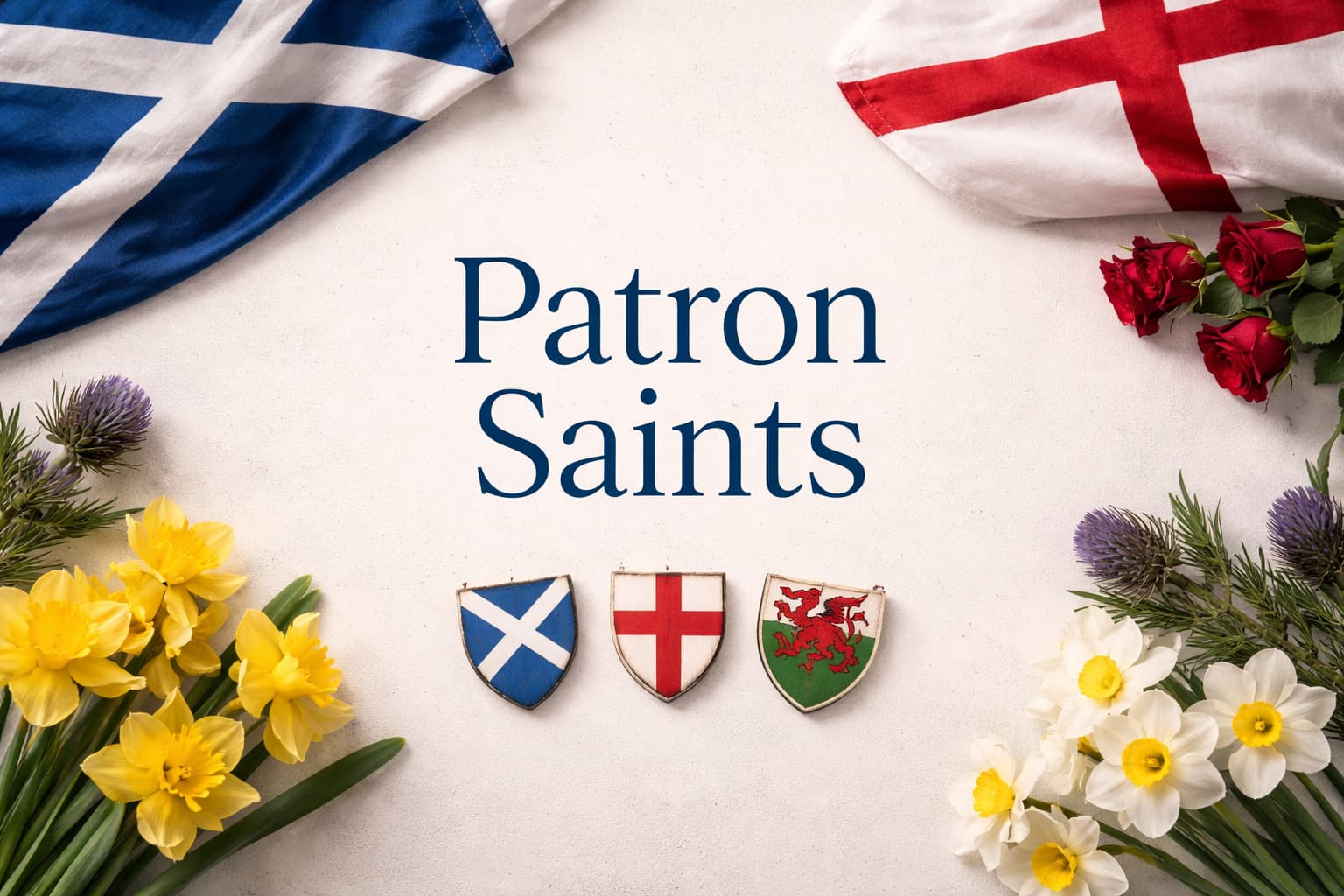
Struggling to remember who’s who and when they’re celebrated? In minutes, you’ll master the UK’s patron saints days—dates, flags, symbols, and bank holiday rules—exactly as the Life in the UK Test expects.
We’ll start with a clear definition, give you a one-glance table, add mnemonics and a 60‑second daily drill, then finish with practice questions and an app-powered study plan.
What are the UK patron saints days?
Definition: Patron saints days are national celebration days in which each UK nation honours its patron saint through symbols, flags and traditions. They appear in the Life in the UK Test because they reflect UK nations, cultural traditions and shared heritage.
The four nations and their saints:
England — St George — 23 April
Scotland — St Andrew — 30 November
Wales — St David — 1 March
Northern Ireland — St Patrick — 17 March
These dates matter because the test often checks exact dates, symbols and flags. For an authoritative overview of all four, see BBC Bitesize and the UK Parliament’s explainer on patron saints.
Nation | Patron saint | Date | Flag/cross | Common symbols | Bank holiday? |
|---|---|---|---|---|---|
England | St George | 23 April | St George’s Cross (red cross on white) | Red rose | No |
Scotland | St Andrew | 30 November | Saltire (white diagonal cross on blue) | Thistle | Yes (Scotland) |
Wales | St David | 1 March | Welsh dragon (national flag) | Daffodil | No |
Northern Ireland | St Patrick | 17 March | St Patrick’s Saltire (red diagonal cross on white) | Shamrock | Yes (Northern Ireland) |
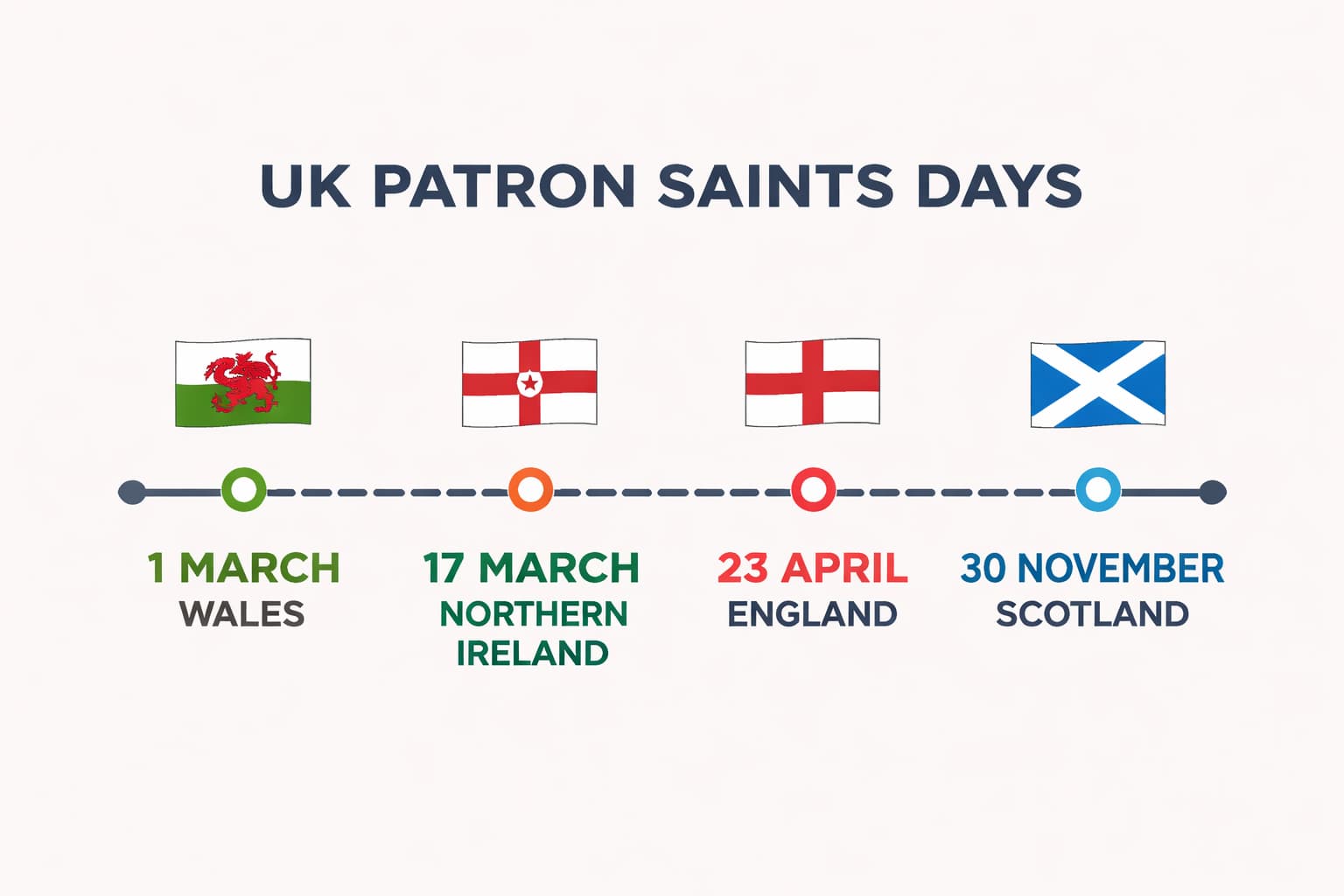
The four saints and their days — clear facts you must memorise
Here are concise, test-ready facts for each of the four patron saints days.
St George’s Day (England) — 23 April
Who: A Roman army officer born in Cappadocia (modern Turkey), martyred for his faith; later seen as England’s protector. See City Hall’s St George facts and coverage noting his wider links in The Independent.
Why England’s patron: Favoured by medieval kings; by 1415 George was named England’s official patron saint.
Flag & symbols: St George’s Cross (red cross on white); red rose.
Celebrations: Flags, civic events, church services; no official bank holiday.
Exam angle: Do not confuse the upright red cross (George) with diagonal crosses (Andrew/Patrick).
St Andrew’s Day (Scotland) — 30 November
Who: Andrew, traditionally regarded as one of Jesus’s first disciples with early connections to Scotland’s identity (see The Independent).
Flag & symbols: The Saltire (white diagonal cross on blue); thistle emblem.
Bank holiday status: Official Scottish bank holiday since 2007 (VisitScotland).
Exam angle: Diagonal white cross on blue belongs to Scotland.
St David’s Day (Wales) — 1 March
Who: Dewi Sant (St David), a 6th‑century Celtic monk, abbot and bishop (Amgueddfa Cymru).
Symbols: Leek and daffodil; national flag is the red dragon (Y Ddraig Goch). Celebrations include parades and concerts (Visit Wales).
Bank holiday status: Not an official bank holiday in Wales (though widely observed).
Exam angle: 1 March is Wales — do not mix with St Patrick, also in March.
St Patrick’s Day (Northern Ireland) — 17 March
Who: A 5th‑century Romano‑British missionary and bishop in Ireland (Ulster Museum).
Symbols & celebrations: Shamrock; parades and global celebrations among the Irish diaspora. It is a public holiday in Northern Ireland (Discover Northern Ireland).
Exam angle: 17 March is Northern Ireland; diagonal red cross (St Patrick’s Saltire) appears in some heraldic contexts.
Background reading on the historic significance of patron saints in the UK is available at Historic UK.
How patron saints days are celebrated across the UK
While each nation leads with its own symbols and customs, there are shared themes—flags, flowers, community events, and music—rooted in regional identity.
Common traditions: flags, flowers, foods, parades
England (23 April): St George’s flags on buildings; red roses; church services; local fairs.
Scotland (30 November): Saltire displays; traditional music and dance; cultural festivals; some workplaces observe the bank holiday.
Wales (1 March): Children wearing traditional dress; leeks and daffodils; Eisteddfod-style performances; parades.
Northern Ireland (17 March): Shamrocks, parades, live music; public holiday events in towns and cities.
Note: Cornwall celebrates St Piran’s Day (5 March), with the black flag bearing a white cross—an extra cultural touchpoint beyond the Life in the UK core syllabus (St Piran’s Day and its flag).
Accents, dialects and identity: what you might hear on the day
Celebrations often highlight regional accents and dialects through greetings, songs and speeches:
Wales: You might hear “Dydd Gŵyl Dewi Hapus!” (Happy St David’s Day) and Welsh-language songs.
Scotland: Scots and Scottish Gaelic words feature in music and toasts during St Andrew’s events.
Northern Ireland: Irish traditional music sessions; references to Irish Gaelic phrases in festivities.
England: A mix of regional English accents at civic events celebrating St George.
For the test, simply recognise that accents and local languages are part of cultural identity; no phonetics are required.
Are they bank holidays? What varies by nation
Quick answer:
Scotland (St Andrew’s Day): Yes, official bank holiday since 2007.
Northern Ireland (St Patrick’s Day): Yes, public holiday.
England (St George’s Day): No.
Wales (St David’s Day): No.
Test-ready facts and common traps
Five facts the exam loves to ask
1 March — St David — Wales — leek/daffodil
17 March — St Patrick — Northern Ireland — shamrock — bank holiday
23 April — St George — England — red rose — St George’s Cross
30 November — St Andrew — Scotland — thistle — Saltire — bank holiday
Cross shapes matter: Upright red (George), diagonal white (Andrew), diagonal red (Patrick).
Easy-to-mix details and how to avoid confusion
Thistle vs rose: Thistle is Scotland; rose is England.
Saltire vs St George’s Cross: Saltire is diagonal white on blue (Scotland); St George’s is upright red on white (England).
Two saints in March: 1 March (David/Wales), 17 March (Patrick/Northern Ireland). Think “Wales first, Ireland later”.
Bank holiday trap: Only Scotland (Andrew) and Northern Ireland (Patrick).
Memory hacks to lock in the dates, symbols and flags
Month mnemonics you’ll remember
Two in March: 1 = Wales (start of the month, start of spring blooms: daffodil); 17 = Northern Ireland (mid‑month, global parades).
April for England: 23 April — picture an upright red cross like a number “+” in your calendar.
End of year Scotland: 30 November — a crisp winter sky behind the white diagonal Saltire.
Visual associations and quick sketch prompts
England: draw a red rose over a red upright cross.
Scotland: sketch a white “X” on a blue rectangle with a small thistle.
Wales: a red dragon next to a daffodil and leek.
Northern Ireland: a shamrock beside a red diagonal “X” on white.
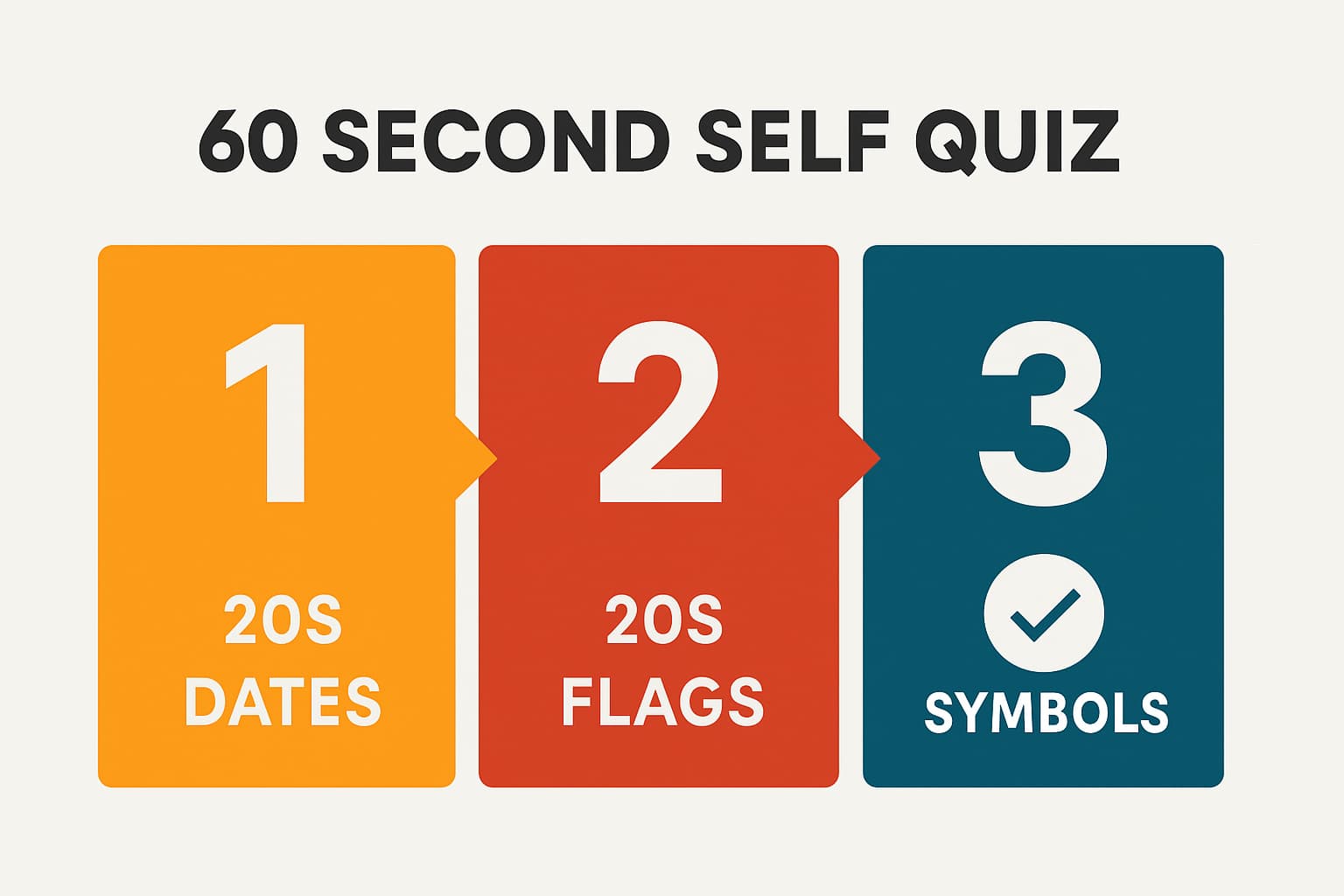
The 60-second self‑quiz routine
20 seconds — Dates: Whisper: 1 Mar (Wales), 17 Mar (NI), 23 Apr (Eng), 30 Nov (Sco).
20 seconds — Flags/crosses: Upright red (George), white diagonal on blue (Andrew), red diagonal on white (Patrick), dragon (Wales national flag).
20 seconds — Symbols & bank holidays: Rose/No; Thistle/Yes; Daffodil/Leek/No; Shamrock/Yes.
10 practice questions you should nail today
Mixed-difficulty sample questions
Which patron saint is celebrated on 1 March, and which symbols are worn?
Which UK nations treat their patron saints day as an official bank/public holiday?
Name the flag associated with St Andrew.
On what date is St George’s Day marked in England?
Which flower is linked with England’s patron saint?
True or false: St Patrick’s Day is a public holiday in Northern Ireland.
Match the cross to the nation: red diagonal; white diagonal; upright red.
Which nation’s flag features a red dragon, and which saint’s day is associated with it?
In which month do both St David’s Day and St Patrick’s Day occur?
List the four patron saints days in calendar order.
Hard Mode ideas to stress-test recall
Given “thistle” and a “white diagonal cross”, provide the nation, saint, and date.
Picture a red diagonal cross: name the day, nation, and whether it’s a bank holiday.
Explain the difference between St George’s Cross and St Patrick’s Saltire in one sentence.
Rapid-fire: You have 10 seconds to say all four dates and emblems.
Learn faster with the Life in the UK Test App
If memorising dates and flags feels daunting, the Life in the UK Test App makes it simple with official materials, a smart assistant and realistic mocks—so you pass first time.
Use official study materials and Brit‑Bear for quick clarifications
Optimised official content: Read the exact facts on saints, symbols and bank holidays without distractions.
Brit‑Bear assistant: Ask, “How do I remember St Andrew’s Saltire?” and get instant, friendly explanations.
Complement with our guide: How to Prepare for Life in the UK Test.
Drill the 650+ question bank and realistic mock tests (incl. Hard Mode)
Targeted culture sets: Filter for culture topics (patron saints days, festivals, flags) and practise in focused sprints.
Hard Mode mocks: Fast flag/symbol crossovers train you for tricky date swaps and lookalike crosses.
See our review: Best Life in the UK Test App 2025: Ultimate Guide.
Track your readiness score and study offline anywhere
Readiness score: Watch your score climb as you master dates, flags and symbols; spot gaps before test day.
Offline access: Keep revising on the bus or during lunch with no signal required.
More strategy tips: Ace the Life in the UK Test with Proven Strategies.
Download the app
Start practising the saints, symbols and bank holidays now:
Download on App Store: Install on iOS
Get it on Google Play: Install on Android
Related syllabus areas to review next
Festivals overview: Remembrance Day to Diwali
Build broader context by exploring key UK festivals and commemorations. This helps anchor where patron saints days sit among national occasions.
Sport and culture you must recognise
Know the big ones—Wimbledon, the Grand National, and more—to deepen cultural literacy. See our English culture essentials.
British scientists and the UK’s global ties
Round out your revision with scientists and the UK’s role in Europe and the Commonwealth. Try: Top British Scientists to Know.
Quick FAQs on UK patron saints days
Why does Northern Ireland celebrate St Patrick’s Day?
St Patrick is the foremost patron saint of Ireland. His day on 17 March is a public holiday in Northern Ireland, marking the arrival of Christianity and Irish heritage.
Is St David’s Day a bank holiday in Wales?
No. It’s widely celebrated but not an official bank holiday in Wales.
Why is St George linked with England?
Medieval kings championed him as a protector; by 1415 he was England’s official patron saint. The St George’s Cross remains a core English emblem.
Do you need to know flags and symbols for the test?
Yes. Expect questions on dates, symbols (rose, thistle, leek/daffodil, shamrock) and flag/cross shapes.
Summary and next steps
Key takeaways at a glance
1 Mar — Wales — St David — leek/daffodil — no bank holiday
17 Mar — Northern Ireland — St Patrick — shamrock — bank holiday
23 Apr — England — St George — red rose — no bank holiday
30 Nov — Scotland — St Andrew — thistle — bank holiday
Your 7‑day micro‑plan for culture topics with the app
Day 1: Read saints overview in the app; ask Brit‑Bear two clarifying questions.
Day 2: Drill 20 culture questions; practise the 60‑second self‑quiz.
Day 3: One full mock; review explanations for any saints/flags errors.
Day 4: Hard Mode mini‑set on flags and symbols (10 minutes).
Day 5: Refresh mnemonics; retake missed items; watch the readiness score.
Day 6: Second full mock under timed conditions.
Day 7: Light review; final 60‑second drill; sleep early.
Ready to lock it in? Install the Life in the UK Test App on iOS or Android and turn dates and flags into instant recall.
Published
January 3, 2026