B1 Speaking Success: Smart SELT Test Practice Guide
Master SELT test practice for B1 Speaking & Listening. Compare exams, get a 4-week plan, model language and test-day tips. Pass faster—learn how.
Need B1 for ILR or British citizenship? This guide makes SELT test practice simple, focused and effective—so you pass first time.
Below you’ll find: what the B1 Speaking & Listening test involves, how to choose between IELTS Life Skills B1 and Trinity GESE Grade 5, the exact examiner criteria, a 4‑week plan (plus a 7‑day rescue), model language, realistic prompts, and a calm test‑day checklist.
What the B1 SELT Speaking and Listening Test Involves
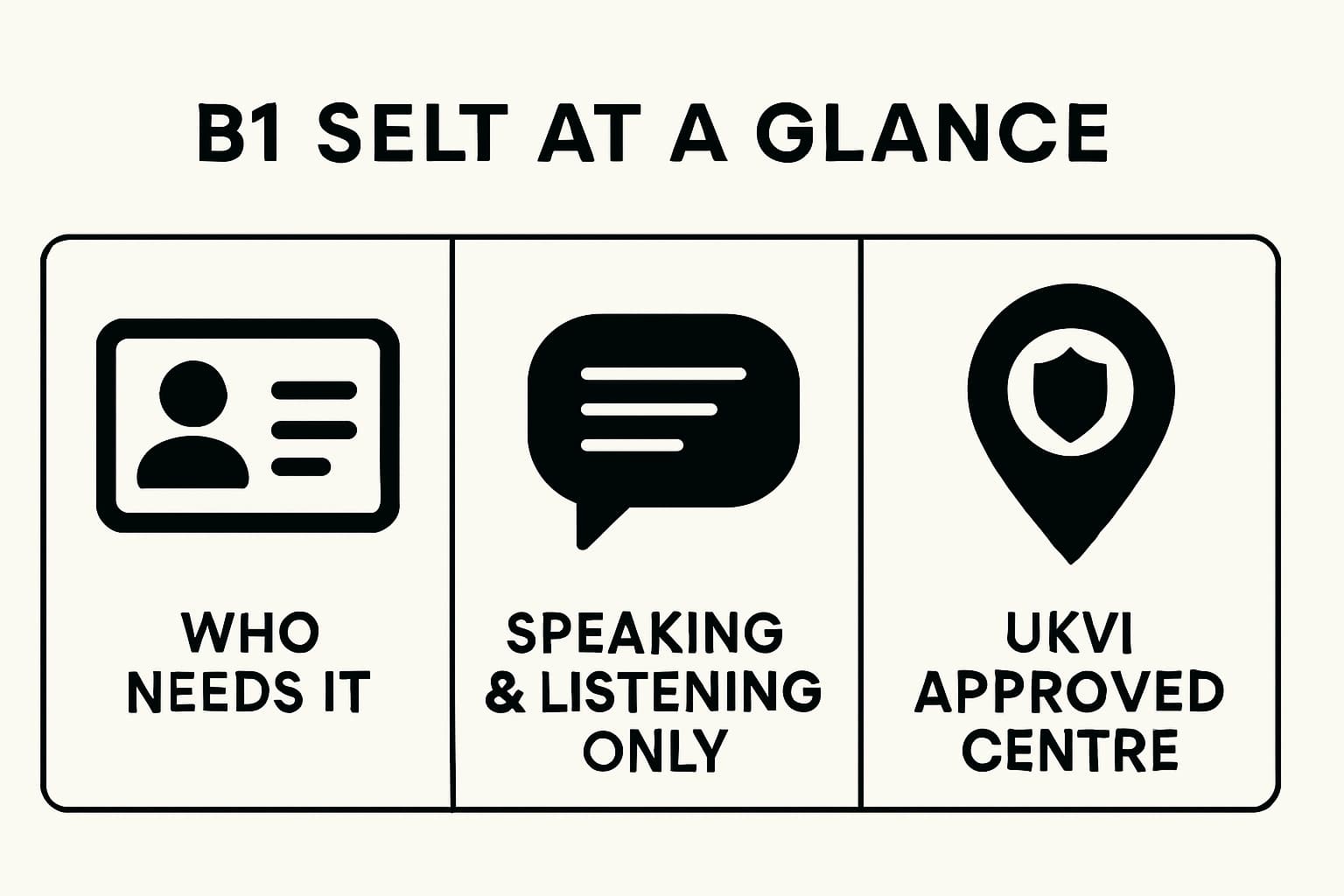
The B1 English test used for UK immigration assesses only speaking and listening—reading and writing are not tested for ILR or naturalisation. You must take an approved Secure English Language Test (SELT) at a UKVI centre to meet the Knowledge of Language and Life (KoLL) English requirement. See the Home Office guidance and approved routes on gov.uk before you book.
Purpose: Prove B1 speaking and listening for Indefinite Leave to Remain (ILR) or British citizenship.
Format: Short, in‑person interview tasks on everyday topics (e.g., work, home, family), often including a discussion and a role‑play. Typical duration: about 8–12 minutes, depending on provider.
Proof: After passing, you’ll receive a SELT unique reference number to include in your application.
Only tests from approved providers are accepted for settlement and naturalisation—most commonly IELTS Life Skills B1 and Trinity College London GESE Grade 5 at UK‑based SELT centres.
Who needs B1 for ILR and British citizenship
You must meet the KoLL English language requirement unless exempt (for example, citizens of majority English‑speaking countries or certain age/medical exemptions). For most ILR and citizenship applicants, this means passing a B1 level speaking and listening SELT with an approved provider.
If you used a B1 SELT for a successful ILR application, you generally don’t need to pass another English test for naturalisation, but you will still need the Life in the UK Test if not already passed.
Always check the latest Home Office KoLL guidance before applying.
For a wider view of your route, see our Indefinite Leave to Remain: Step‑by‑Step Roadmap and Life in the UK Test and B1: Do You Need Both in 2025?
Approved exams and staying up to date
For settlement and citizenship, the accepted B1 options in the UK are:
IELTS Life Skills B1 (speaking & listening)
Trinity GESE Grade 5 (speaking & listening)
These must be taken at UK‑based UKVI SELT centres. Before booking, always verify the current approved SELT providers and rules on gov.uk.
Choose the Right Exam: IELTS Life Skills B1 vs Trinity GESE Grade 5
Both exams meet the requirement, but the experience differs. Use the comparison below to decide which suits your strengths, travel distance, and scheduling needs.
Format and timing at a glance
Feature | IELTS Life Skills B1 | Trinity GESE Grade 5 |
|---|---|---|
Interaction | With examiner and another candidate | One‑to‑one with examiner |
Focus | Speaking & listening on everyday topics | Speaking & listening on familiar topics |
Typical timing | ~18 minutes (varies by centre) | ~10 minutes (varies by centre) |
Tasks | Information exchange, discussion, listening to prompts | Discussion, interactive task/role‑play, sustained talk |
Location | UKVI SELT centres in the UK | UKVI SELT centres in the UK |
Results timeline | Typically within about 7 days; check centre | Often same‑day provisional; certificate follows; check centre |
Always confirm current formats and result times on the provider’s website when you book.
Booking, locations, and result times
Choose your exam (IELTS Life Skills B1 or Trinity GESE Grade 5).
Find a UKVI SELT centre with suitable dates near you.
Prepare your ID (passport, BRP, etc.) exactly as required by the centre.
Book and pay; keep your confirmation email.
Check result delivery (online account, email, collection, post) and expected timeframe.
For a deeper comparison, read B1 English Test for ILR & Citizenship: Pick the Right Exam.
Which option suits your situation
Prefer one‑to‑one? Trinity GESE Grade 5 avoids paired‑candidate interaction.
Comfortable with paired tasks? IELTS Life Skills B1 may feel natural if you like discussion with another candidate.
Need fast confirmation? Trinity centres often give same‑day provisional results (confirm locally).
Travel and availability: Choose the easiest centre to reach on your best date—reduced stress improves performance.
Exactly What B1 Level Means (and How to Show It)
CEFR B1 is an intermediate level: you can handle most everyday situations, follow clear speech on familiar topics, and express opinions with connected ideas. On test day, examiners want clear, relevant communication, not perfect grammar.
B1 functions you must demonstrate
Describe experiences and events (past), routines (present), and plans (future).
Give opinions and simple reasons; agree/disagree politely.
Plan with a partner: make suggestions, compare options, reach a decision.
Ask for clarification and repair misunderstandings naturally.
Keep the conversation going with follow‑up questions and linking phrases.
Typical topics and vocabulary domains
Home & housing, family & friends, work & study, schedules & travel
Health, shopping & money, food & leisure, local services
Community, weather, transport, technology in daily life
Build lexical sets and collocations for these themes to avoid repetition.
Planning ahead? You’ll also need the Life in the UK Test for KoLL. Save time with the Life in the UK Test App—650+ explained questions, realistic mocks (including Hard Mode), Brit‑Bear smart assistant, readiness score, and offline access. Download on App Store or Get it on Google Play.
What Examiners Score You On
Target your SELT test practice on the criteria that matter. While wording varies, assessors typically evaluate:
Fluency and interaction
Speak at a steady pace; pause to think, not to stop.
Use discourse markers: firstly, actually, to be honest, in my view, because, so, for example.
Keep it interactive: ask follow‑up questions and respond to your partner’s ideas.
Pronunciation and intelligibility
Stress key words in a sentence: I’d prefer the train because it’s cheaper.
Chunk ideas: use short thought groups and clear intonation.
Prioritise clarity over accent—be consistent with sounds you can produce well.
Grammar range and accuracy
Core B1 toolkit: past simple, present perfect, future forms (going to/will), comparatives/superlatives, first conditional.
Self‑correct smoothly: I go—sorry—I went last weekend.
Vocabulary range and appropriacy
Add topic‑specific words and collocations: monthly rent, rush hour, book an appointment, balanced diet.
Paraphrase if stuck: I don’t know the word, but it’s like...
Listening and task achievement
Catch gist and key details (numbers, dates, names, times).
Repair early: Could you repeat that, please? / Do you mean...? / So we should meet at six, right?
Meet the purpose: if it’s a planning task, end with a clear decision.
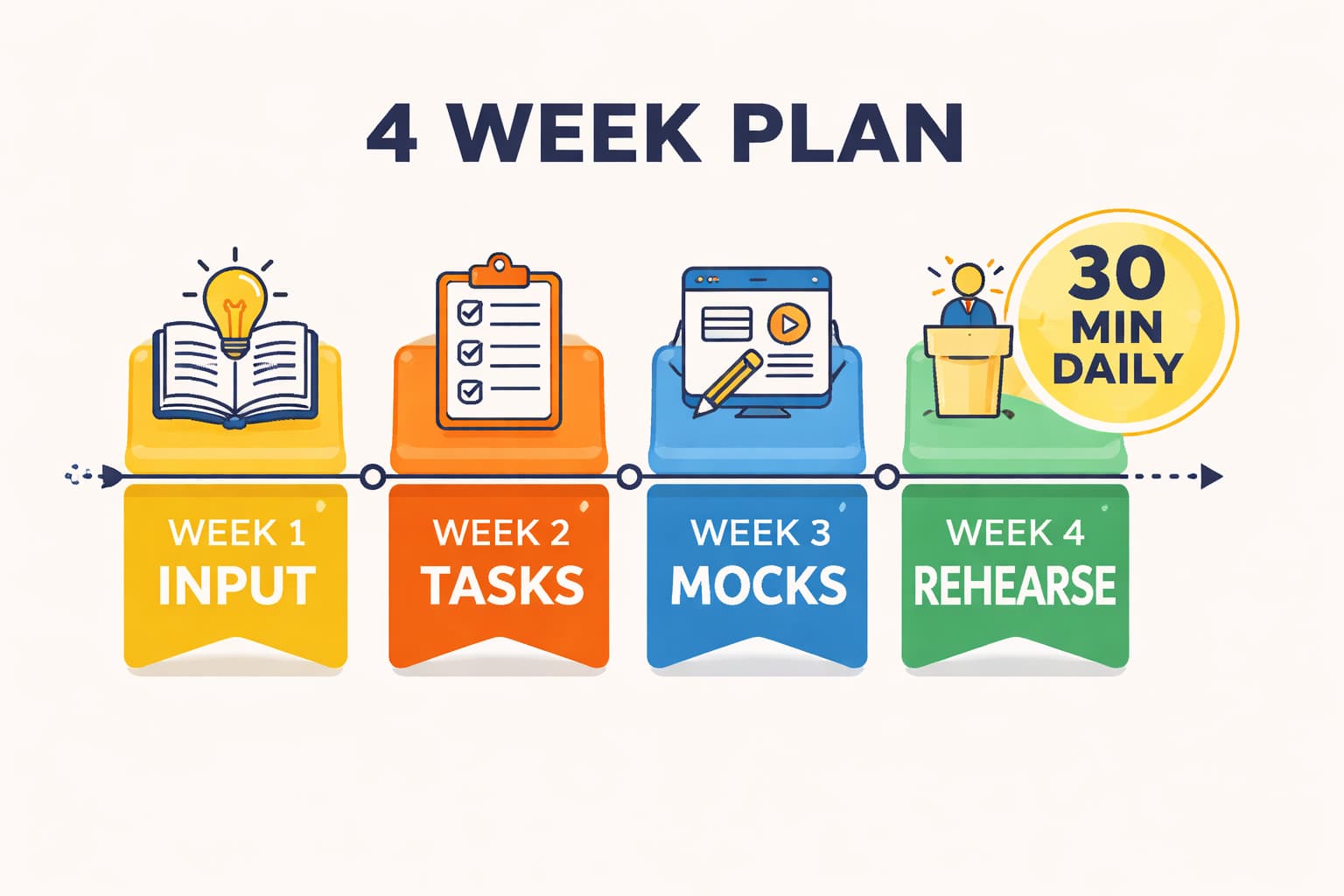
4-Week SELT Test Practice Plan (Plus a 7-Day Fast Track)
Follow this timetable to build fluency, accuracy and listening precision without burnout.
Week-by-week roadmap
Week 1 – Input & Baseline: Shadow short dialogues daily; record a 2‑minute self‑introduction; note grammar gaps. Listening micro‑drills for numbers, dates, times.
Week 2 – Task Skills: Practise planning/decision tasks and role‑plays; add turn‑taking phrases; expand topic vocabulary (work, housing, travel).
Week 3 – Exam Conditions: Two timed mocks (IELTS Life Skills or GESE‑style); analyse recordings against criteria; target your top 3 issues.
Week 4 – Rehearse & Refine: Daily 10‑minute warm‑ups; one full mock every other day; polish pronunciation stress and repair strategies.
Daily 30-minute routine
Warm‑up (4 mins): Mouth stretches, word stress drills, 30 seconds of free speaking.
Listening micro‑drill (6 mins): Numbers/dates/times; repeat and write quick notes.
Speaking task (12 mins): Choose a prompt; record 2–3 minutes; switch roles or answer follow‑ups.
Feedback (6 mins): Re‑listen; mark 2 pronunciation fixes and 2 grammar fixes; re‑record a cleaner version.
Phrase bank (2 mins): Add one opener, one linker, one clarifier to your notebook.
7-day rescue plan
Day 1–2: Learn essential phrases, stress patterns, and repair language; 2 short mocks.
Day 3–4: Alternate planning tasks and personal‑topic talks; focus on fluency over perfection.
Day 5: Full timed mock; analyse; fix your top 3 priority issues.
Day 6: Targeted pronunciation + listening for numbers/dates; one mini‑mock.
Day 7: Light review, confidence rehearsal, sleep well.
Practice Techniques That Actually Work
Shadowing and recording yourself
Shadow 30–60 seconds of natural speech; match stress, rhythm and linking.
Record yourself answering a prompt, then compare against your shadow model.
Fix one issue per day: word stress, final consonants, or reduced pauses.
Frameworks for longer answers
Use flexible templates (not scripts) to stay coherent:
Opinion: My view is… because… For example… Overall…
Past experience: When… happened, I felt… The best/worst part was… After that…
Planning: Option A…, Option B… Let’s compare cost/time. I suggest… Shall we decide?
Listening micro-drills
Numbers: Hear “thirty” vs “thirteen”; repeat, then say three examples aloud.
Dates/times: Note the day, time and location from short clips; confirm aloud: So, Saturday at half past two.
Names/spellings: Practise alphabet; echo spellings: That’s B‑R‑I‑A‑N, right?
Partner and solo practice ideas
Role‑plays: booking a GP appointment; choosing a flat; planning a day trip on a budget.
Conversation starters: a recent problem you solved; a place you’d like to visit and why.
Solo drills: pick a random object and speak for 60 seconds using five linkers: firstly, also, however, for example, finally.
Common Task Types and Model Language
Introducing yourself and daily life
Openers: I’m…, I live in…, I work/study in…
Expanding: Usually, I…, Recently, I…, At the weekend, I…
Hometown/work: It’s a busy/quiet area; My job involves…; I’m responsible for…
Planning and decision-making with a partner
Suggesting: How about…? We could…
Comparing: This is cheaper/faster/more convenient, but…
Deciding: Shall we choose… then? Let’s go with…
Inviting: What do you think? Do you agree?
Opinions, agreeing, and disagreeing politely
Opinions: In my view…, I tend to think…
Agreeing: I feel the same; That makes sense.
Disagreeing: I see your point, however…, I’m not sure about…
Describing past experiences and future plans
Past: Last year I started…, The best thing was…
Present perfect: I’ve lived here for three years; I’ve recently changed jobs.
Future: I’m going to book; I’ll probably visit my friend next month.
Sequencing: First…, Then…, After that…, Finally…
Making arrangements: time, place, and cost
Could we meet on… at…?
How much does it cost per…?
Just to confirm, we’ll meet at… on… for…
Realistic SELT Test Practice Prompts
Prompt set 1: IELTS Life Skills style
Information exchange: Your partner wants to join a gym. Ask about price, opening hours, location, and classes. Decide which gym is best.
Listening to an audio prompt: You hear details about a community event. Note the date, time, place and cost. Confirm with your partner.
Discussion: Talk about ways to save money on travel; agree on three tips.
Prompt set 2: Trinity GESE Grade 5 style
Topic discussion: A hobby you enjoy: how you started, how often, what you’ve learned.
Interactive task: Role‑play phoning a local clinic to book an appointment; clarify time and cost.
Conversation: Compare two housing options; choose one and justify.
How to self-mark and improve
Record your response under time pressure.
Rate 1–5 for fluency, pronunciation, grammar, vocabulary, listening/achievement.
Identify 3 fixes: one pronunciation, one grammar, one vocabulary.
Re‑record the same prompt applying your fixes.
Log errors and wins; repeat with a new prompt tomorrow.
Fix the Top Mistakes Candidates Make
Short answers and awkward silences
Use expansion frames: Because…, For example…, Also…, As a result…
Keep talking while you think: Let me think for a second… I’d say…
Over-memorised scripts
Memorise phrases, not paragraphs. Personalise every answer.
Practise with varied prompts so you respond to meaning, not memory.
Misunderstandings and repair strategies
Sorry, could you repeat that, please?
Do you mean…? / So you’re suggesting… right?
Confirm decisions: Great, so we’ll choose the bus at ten.
Pronunciation pitfalls to watch
Word stress: phoTOgraph, photoGRAphic, phoTOGrapher.
Sentence stress: emphasise key content words.
Consonant clusters: practice ends: next, helped, asked.
Test-Day Checklist and Nerves Control
Booking, ID, and security rules
Bring correct ID (e.g., passport/BRP) matching your booking.
Arrive early with your confirmation email and any required photos.
Follow centre rules on personal items, phones, and security checks.
Know your SELT reference will be issued after passing—keep it safe for your application.
Warm-up routine and pacing
10 minutes before: breathe 4‑4‑6, then stress drills on your phrase bank.
Enter with your opener ready: To start, I’d like to say…
Pace: short sentences, clear stress, keep eye contact.
Interacting with another candidate
Invite: What do you think? / Would you prefer…?
Build: I agree, and also… / I see, but maybe…
Close: Shall we decide on… then?
After B1: Pass the Life in the UK Test Next
To complete KoLL for ILR or citizenship, most applicants need both a B1 SELT and the Life in the UK Test. Study efficiently and avoid retakes with the Life in the UK Test App:
Official‑style materials streamlined for faster recall
Brit‑Bear smart assistant to target weak areas
Readiness score to know when you’re test‑ready
650+ explained questions and realistic mock tests, including Hard Mode
Offline access for study anywhere
Download on App Store or Get it on Google Play. For broader context, see How to Prepare for the Life in the UK Test and How to Get British Citizenship.
FAQs for 2025
How long is my B1 SELT result valid
Typically, SELT results are valid for up to 2 years for immigration applications. Rules can change—always confirm current validity on gov.uk (Appendix KoLL).
Can I retake if I do not pass
Yes. You can usually rebook; waiting periods vary by provider and centre availability. Review your recordings, adjust your plan, and focus on your top 3 weaknesses before retesting.
Are remote or online B1 tests accepted
For ILR and citizenship, tests generally must be taken in person at UKVI‑approved centres. Check the current approved list and policies on gov.uk.
What accents are acceptable
Any accent is fine—examiners look for clear, intelligible speech with appropriate stress and rhythm, not a native accent.
Do I need both B1 and the Life in the UK Test
Most ILR and citizenship applicants need both (KoLL requirement). If you used a B1 result for ILR, you typically don’t need a new English test for naturalisation, but you must pass Life in the UK if not already.
Next steps: Choose your exam, schedule 4 weeks of focused practice, and line up your Life in the UK prep. Save time with the Life in the UK Test App or Get it on Google Play.
Published
January 7, 2026