Can British Citizenship Be Revoked? What Puts It at Risk
Short answer: yes—British citizenship can be revoked, but only in narrowly defined, serious circumstances. This guide explains when that can happen, the legal protections in place, and practical steps to keep your status safe.
We’ll cover the two legal routes (deprivation vs nullity), who can be affected, the process and appeal options, the impact on families, and a safety checklist for new citizens. You’ll also see real case examples, myths vs facts, and how the Life in the UK Test App helps you stay on track to citizenship.
Quick Answer: Yes—But Only in Narrow, Serious Cases
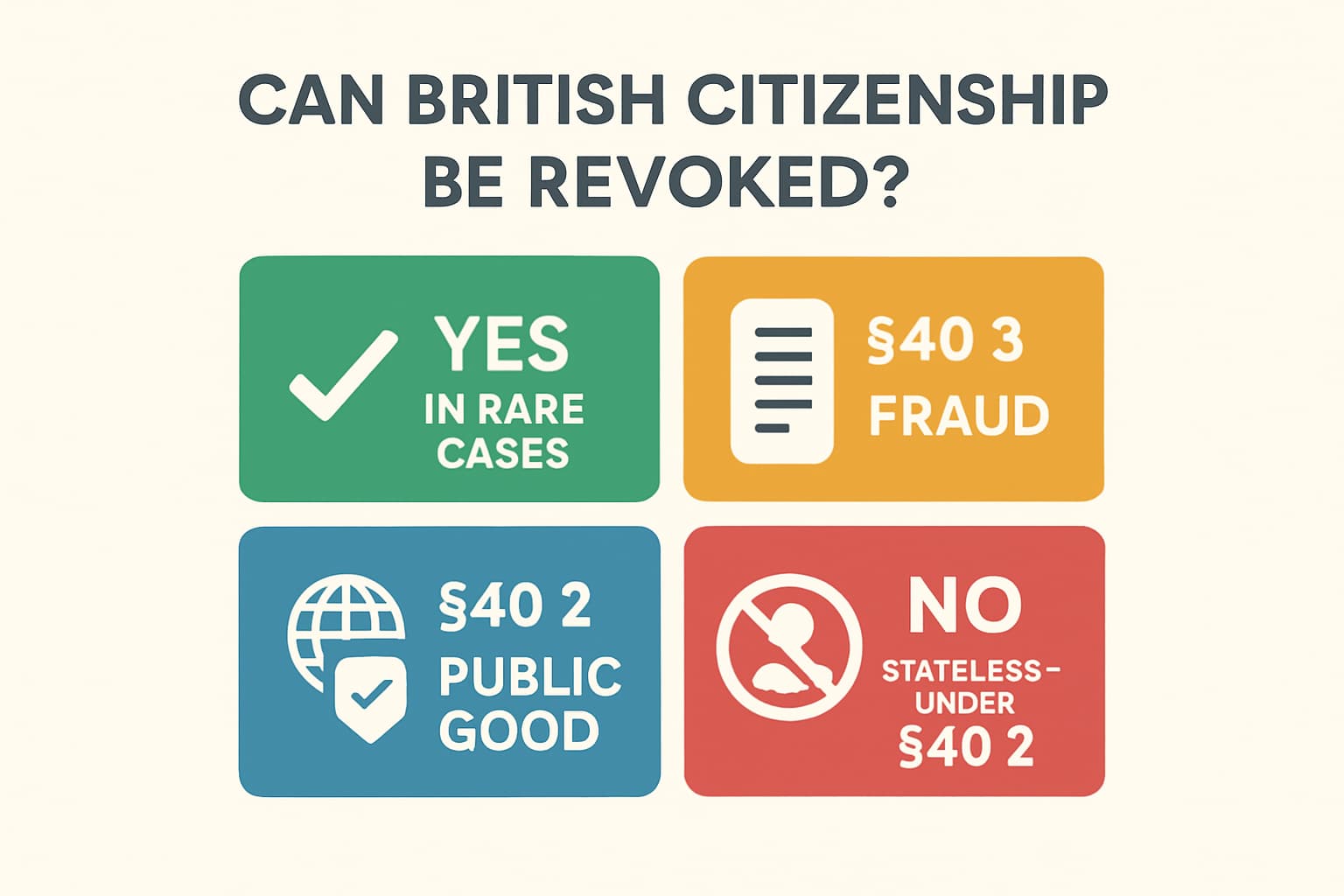
If you’re wondering “can British citizenship be revoked?”, the answer is yes, but it’s rare and tightly controlled by law. The Home Secretary can remove citizenship from people who: (1) obtained it by fraud or other deception; or (2) pose a serious threat where deprivation is considered conducive to the public good. Safeguards exist, including strict evidence standards and a prohibition on creating statelessness in public-good cases.
It’s uncommon: Used against fraudsters and the most serious offenders (e.g., terrorism, espionage, serious organised crime).
Two legal routes: Deprivation (removing a valid grant) or nullity (treating the grant as never valid due to identity impersonation).
Statelessness protection: Deprivation on “public good” grounds cannot make you stateless.
Deprivation vs. Nullity: Two Different Legal Routes
Deprivation of citizenship (definition): The government removes an existing British citizenship status by order, because of fraud or because it’s deemed conducive to the public good.
Nullity (definition): The grant of citizenship is treated as never having happened, typically where there was wholesale impersonation—the person assumed the identity of someone else who would have qualified.
Feature | Deprivation | Nullity |
|---|---|---|
What it means | Valid grant removed | Grant treated as never valid |
Typical trigger | Fraud / public good | Impersonation of another real person |
Statelessness | Not allowed for public-good cases; may occur for fraud-based cases | N/A (citizenship never existed) |
Status after decision | Does not revert to previous immigration status automatically | Reverts to prior immigration status (as if grant never happened) |
Official guidance distinguishes deprivation from nullity and explains the impersonation test for nullity. See the Home Office British citizenship guidance and nullity guidance.
Who Can Be Affected: Naturalised, By Descent, and By Birth
Naturalised or registered citizens: Can face deprivation for fraud (s40(3)) or if considered conducive to the public good (s40(2)).
Citizens by birth: Generally only at risk under s40(2) (public good), and not if it would make them stateless.
Dual nationals: Public-good deprivation cannot render a person stateless; dual nationality often determines if s40(2) can apply.
Children: Special care applies; decisions must consider best interests of affected children individually.
To understand acquisition routes, see our plain-English guide on how to get British citizenship and our explainer on British citizenship by descent. For dual nationality rules, read dual citizenship in the UK.
The Law: Grounds for Deprivation Under the British Nationality Act 1981
Section 40 of the British Nationality Act 1981 (BNA 1981) sets out the statutory grounds. In practice, the Home Secretary uses two routes:
Fraud, false representation, or concealment of material fact (s40(3))
Conducive to the public good (s40(2))
See an overview of Section 40(3) wording and the statelessness safeguard for public-good cases in tribunal summaries: UI-2023-000860.
Fraud, False Representation, or Concealment of Material Fact (s40(3))
Citizenship may be removed if it was obtained by fraud, false representation, or concealment of a material fact. Examples include concealing a criminal record that would have led to refusal, a sham marriage used to obtain underlying leave, or using bogus identity details that secured status.
Standard of proof: On the balance of probabilities, and based on sound evidence—not speculation.
Statelessness: This route can result in statelessness because the law targets the integrity of the original grant.
Fictitious vs impersonation: If you falsified some details, that is typically deprivation (s40(3)), not nullity. Wholesale impersonation of another real person points to nullity.
Sources: Home Office deprivation guidance and nullity guidance.
Conducive to the Public Good (s40(2))
This route is used in exceptional cases concerning national security or serious criminality (e.g., terrorism, espionage, war crimes, serious organised crime). The government frames it as protecting public safety and national security. Crucially, deprivation under s40(2) cannot render you stateless.
Used against “the most dangerous people,” according to official reporting and inspection material.
Appeals often involve sensitive evidence and may go to the Special Immigration Appeals Commission (SIAC).
References: Independent inspection and government statements on deprivation powers as a national security tool (inspection report), and tribunal summary confirming the broad statelessness bar on s40(2) (UI-2023-000860).
What Is Not Grounds for Deprivation
Most people asking about losing British citizenship are worrying unnecessarily. These alone are not typical grounds:
Minor motoring offences or fixed penalty notices
Divorce or family disputes
Ordinary civil debts or credit problems
Post-grant mistakes that don’t relate to how citizenship was obtained
Conduct that would make you stateless if used under s40(2)
Preparing to apply for citizenship or ILR? Steer clear of avoidable retests and delays. The Life in the UK Test App gives you official content, 650+ questions with explanations, and a smart readiness score so you pass first time. Download on the App Store or Get it on Google Play.
Process: How Deprivation Cases Start and What Happens Next
Notice of intention: Home Office writes to you with reasons and evidence summary.
Your representations: You can respond with evidence and legal arguments.
Decision: The Home Secretary decides whether to make a deprivation order.
Appeal: You may appeal—route depends on the legal ground (SIAC for s40(2); First-tier Tribunal for s40(3)).
Outcome: Order upheld, varied, or set aside on appeal; further appeals may follow.
Notice of Intention and Your Right to Respond
You’ll receive a formal notice explaining the proposed action and reasons. This is your chance to provide documents, witness statements, and legal submissions addressing each allegation. Get specialist advice promptly—deadlines can be tight and the right evidence can change outcomes. Official guidance emphasises that decisions must rest on sound evidence, not speculation.
Appeals: SIAC vs First-tier Tribunal
Public-good cases (s40(2)): Appeals go to the Special Immigration Appeals Commission (SIAC). These may involve closed material procedures where sensitive evidence is heard privately with special advocates.
Fraud cases (s40(3)): Appeals go to the First-tier Tribunal (Immigration and Asylum Chamber).
For a snapshot of the statutory wording and the statelessness safeguard, see this tribunal summary.
Status During the Process: Passport, Travel, and Work
Before any order is made: You remain a British citizen. Your passport remains valid unless separately cancelled on other grounds.
After a deprivation order: You are no longer British. Passports are typically cancelled and international travel can be risky. Your right to work and access services depends on any remaining immigration leave or other nationality.
During an appeal: The deprivation order generally remains in force unless a court grants a stay or other interim relief. Seek legal advice urgently.
Impact on Family Members and Children
Deprivation is not automatic for family members. Each person’s status is assessed on its own facts. However, decisions must weigh the best interests of affected children. Recent Upper Tribunal case law has criticised decisions that failed to consider individual children’s circumstances adequately.
Example: In Mujaj [2025] UKUT 349, the Tribunal found the Secretary of State had not lawfully exercised discretion, partly because there was insufficient individualised analysis of the appellant’s minor children.
Post-Ceremony Safety Checklist: Keep Your Status Secure
Most people will never be at risk. Still, good record-keeping and honesty reduce even small risks.
Keep a full copy of your application, supporting documents, and Life in the UK Test pass notification.
Track your travel and residence so you can evidence absences and continuity if ever asked.
Disclose material facts in future dealings with the Home Office; don’t omit information that could matter.
Avoid misrepresentation in any immigration application for you or family; errors here can be revisited later.
Seek advice early if contacted by the Home Office about your status.
Documentation and Honesty: What to Keep and Disclose
Home Office reference numbers, BRP or passport details, and copies of prior visas or ILR.
Proof of identity, name changes, marriages, and divorces.
Criminal record disclosures as required; if in doubt, disclose and explain.
The Home Office applies a balance-of-probabilities test in fraud cases and expects sound evidence. Keeping clear records helps show good faith and accuracy if questions arise later.
If You Spot an Error in Your Application
Write down the issue: What was incorrect, why, and what the correct information is.
Gather proof: Documents that support the correction (e.g., new police certificate, corrected dates, official letters).
Seek legal advice: A solicitor can help you decide whether and how to notify the Home Office.
Act promptly: Proactive honesty is almost always better than delay.
Myth vs Fact: Common Fears Debunked
Myth: A speeding fine means I’m losing British citizenship. Fact: Minor motoring offences are not grounds for deprivation.
Myth: A divorce can revoke my passport. Fact: Family changes don’t remove citizenship.
Myth: Any mistake leads to nullity. Fact: Nullity is about impersonation of another real person.
Myth: Public-good cases can make me stateless. Fact: They cannot under s40(2).
Real-World Scenarios: When Deprivation Has Happened—and When It Hasn’t
Fraud-based deprivation (s40(3)) succeeds: An applicant concealed a disqualifying criminal conviction that directly affected the good character requirement. The Tribunal upheld deprivation on the balance of probabilities with documentary evidence.
Nullity vs deprivation distinction: A person who impersonated another real individual who would have qualified was treated as a nullity case (citizenship deemed never granted). Where details were merely falsified, the route was deprivation instead.
Public-good deprivation (s40(2)) with dual nationality: Deprivation proceeded where the person had another nationality and posed a national security risk. Appeal considered sensitive evidence via SIAC procedures.
Appeal succeeds for procedural fairness: In Mujaj [2025] UKUT 349, the decision was set aside for failure to properly consider impacts on minor children.
Background reading: government and inspection materials on when deprivation is used in practice, and the 2017 Supreme Court-defined understanding of nullity as impersonation of someone who would have qualified if they had applied.
Life in the UK Test Connection: Rights, Responsibilities, and Good Character
The Life in the UK Test covers rights, responsibilities, and the importance of good character—core ideas that also underpin citizenship decisions. Staying accurate and honest in applications aligns with this civic learning and reduces risk long-term.
Study Smarter With the Life in the UK Test App
Learn faster: Complete official handbook content optimised for mobile, guided by Brit-Bear.
Know when you’re ready: A smart readiness score and detailed analytics prevent wasted retests.
Master the questions: 650+ Q&As with explanations, plus mock tests and a Hard Mode.
Study anywhere: Offline access keeps you progressing on your commute or lunch break.
Join thousands who passed on the first try and avoided costly delays. Download on the App Store or Get it on Google Play. Considering your application? See our step-by-step citizenship guide and how to apply for your first British passport.
FAQs
Can British citizenship be revoked for a speeding ticket?
No. Minor motoring offences or fixed penalties do not, on their own, justify deprivation.
Will tax issues or civil debt cause deprivation?
Ordinary tax disputes or debts are not typical grounds. Fraud directly tied to obtaining citizenship is different.
Can public-good deprivation make me stateless?
No. By law, s40(2) cannot be used if it would render you stateless.
Do I lose my passport during an appeal?
After an order, you’re no longer British and your passport is usually cancelled. Appeals don’t automatically restore citizenship.
Who decides deprivation or nullity?
Home Office caseworkers prepare cases; a senior decision-maker authorises the order per published guidance.
Key Legal References and Where to Get Help
Home Office guidance on British citizenship, deprivation, and nullity.
Nullity caseworker guidance and examples of impersonation vs fictitious identity: read here.
Deprivation guidance (standard of proof; decision-making): read here.
Tribunal summaries on s40 and statelessness: UI-2023-000860.
Recent UT case on considering children: Mujaj [2025] UKUT 349.
Government/inspection overview of national security use: read here.
If you receive a notice, consult a qualified UK immigration solicitor. For learning the citizenship process, read our guides on how to get citizenship and dual nationality rules.
Important Note
This guide is for general education only and is not legal advice. Nationality law is complex and fact-specific. If you think you may be affected by deprivation or nullity, seek advice from a qualified UK immigration solicitor immediately.